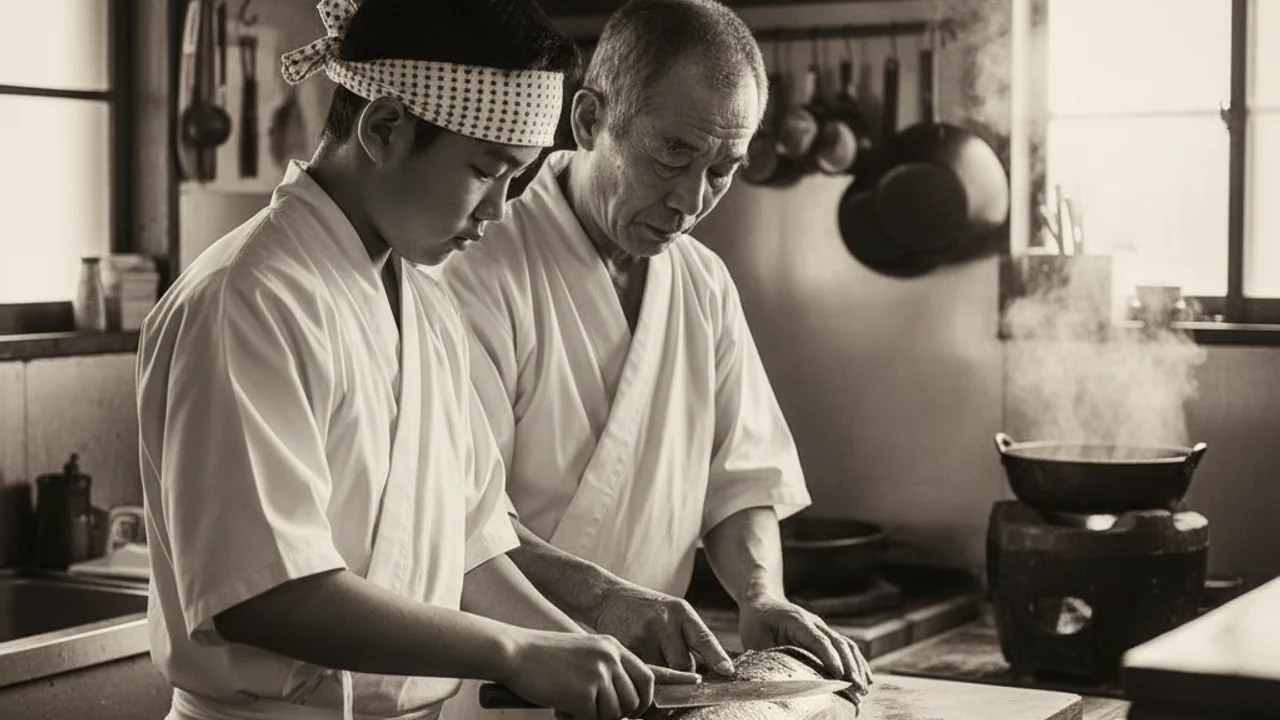
People sometimes ask me how you end up in Rosemont with a counter and a rice obsession. The answer is not quick. It starts thirty years ago, in front of a hot grill, in a craft that had nothing to do with sushi.
The Beginning: Teppanyaki at Shogun
It all started at Steak House Shogun, in Brossard, behind the teppanyaki grill. The flames, the knives spinning, the laughter of guests. For me, cooking was never just a job: it is a performance, an encounter. Teppanyaki taught me that before anything else.
That craft gave me essentials: dexterity, timing, the awareness that the visible gesture is part of the meal. In teppanyaki, you have no right to hesitate. If you hesitate, the guest sees it, the food overcooks, and the moment is lost. I stayed twenty-three years. A lesson in precision that does not fade.
Moving to Sushi: Aiko
The turn toward sushi happened on the Plateau Mont-Royal. There I co-founded Aiko Sushi and, over seven years, welcomed a loyal, curious crowd. Under our drive, Aiko became a reference, and my name something people passed between friends.
That is where, behind the counter, I fell for good into edomae: the tradition of sushi born in Edo, old Tokyo, in the 19th century. No elaborate sauce to hide the product. No needless garnish. Fish, sometimes lightly aged or vinegar-cured, set on perfectly seasoned rice. Technique in service of transparency. I deepened it year after year, by repeating the gesture and listening to the product.
Over time, I also learned what I did not want. Endless menus where everything is available year-round with no regard for season. Spectacle at the expense of the product. Those lessons sharpened my idea of what I would do, one day, if I opened something of my own.
The Innovator: Poké Star
The urge to innovate then led me downtown, behind the Eaton Centre, with Poké Star. At the time, Montréal had barely five poké addresses. I was among the first to believe in it.
Poké is not edomae, but the venture taught me something else: how to make Japanese food accessible, fast, joyful, without sacrificing freshness. The pandemic wrote the end of that chapter. But the idea of quality Japanese cooking, with no ceremony and no discouraging bill, stayed with me.
The Story of Aji Bar Sushi & Izakaya MTL: A Counter Born of ConvictionWhy a counter, why Rosemont, and what the name Aji means.Aji: His Own Counter at Last
Aji is my little gem, matured over all those years. A sushi & izakaya counter, meaning sushi pressed to order and small Japanese plates to share, with omakase as an option, at the counter or at a table, by reservation. The counter facing my station seats only four: it is intimate, and that is the point. I wanted to stay in front, close to people, preparing each piece in full view of whoever will eat it.
Above all, an address that stays accessible to everyone. Montréal is a BYOB city, its diners are curious and well-travelled: everything a counter needs to thrive without taking itself too seriously. Fine Japanese food should be a pleasure you treat yourself to often, not once a year.
Where did Chef Yamamoto move from teppanyaki into sushi?
What Remains After Thirty Years
Thirty years of cooking is a lot of fish handled, rice cooked, nights on your feet, conversations with suppliers. What remains, at bottom, is simple: respect for the product is not an abstract value. It is a daily discipline.
The fish that arrives in the morning deserves time: to be looked at, touched, judged for how it will be best served tonight. Sometimes fresh, sometimes after two days of aging. The answer is never the same. That is why I cannot serve a fixed menu that never changes.
Every night at the counter, I start from zero, in a sense. The ingredients are different, the guests are different, and the sequence I build is different. That is what keeps the format alive after all these years.
The Philosophy of Japanese Cuisine at AjiMa, shun, shokunin, omotenashi: the four principles that guide the kitchen and the counter.Behind the Sushi Counter: A Day at AjiA day at Aji begins with morning fish delivery, works through knife preparation and rice cooking, reaches its peak during service, and close- 1Chef Yamamoto began with twenty-three years of teppanyaki at Steak House Shogun in Brossard.
- 2He moved into sushi at the Aiko counter on the Plateau, where he deepened the edomae tradition.
- 3Poké Star, downtown, taught him to make Japanese food accessible.
- 4Aji is his own counter: sushi & izakaya, omakase as an option by reservation, and above all accessible.
- 5Thirty years of Japanese cooking, all built here in Quebec.
Sit across from Chef Yamamoto at the Aji counter. 929 St-Zotique Est, Montréal.
Make a reservation