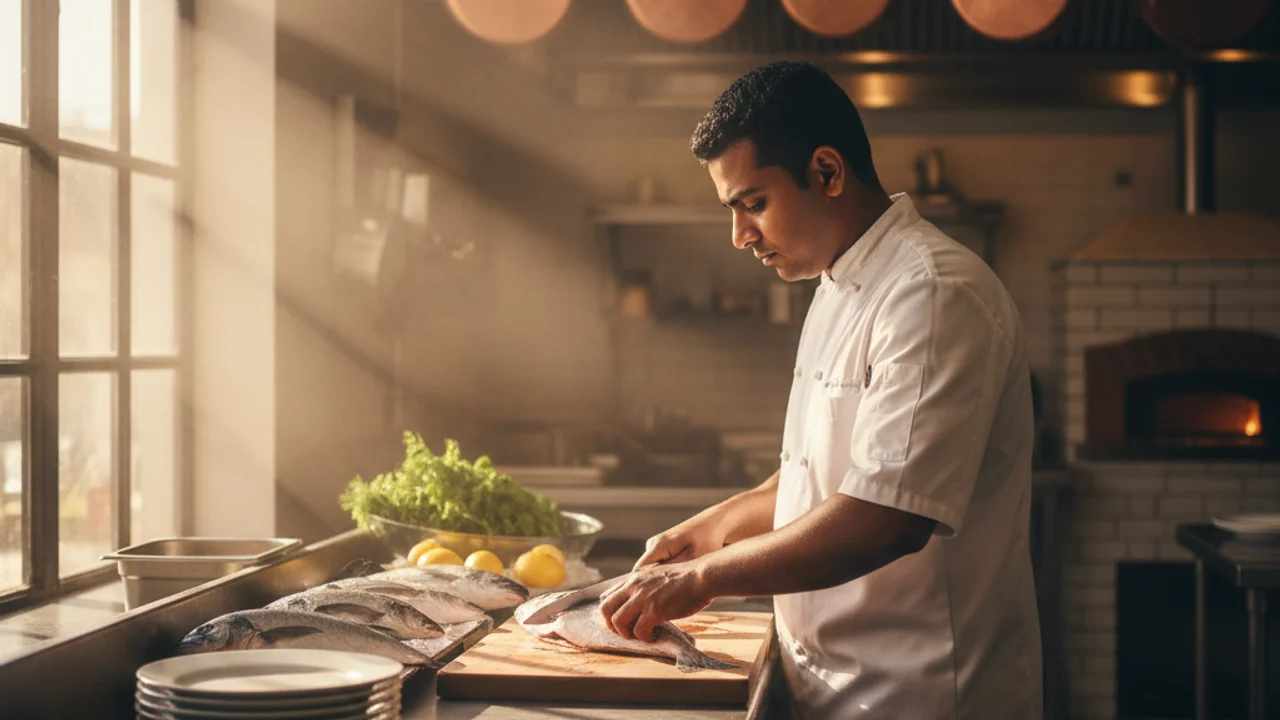
Guests arrive at the counter and see a finished thing: a clean space, a composed chef, fish ready to be pressed into rice. What they do not see is the day that made the evening possible. Here is what that day looks like.
Morning: Fish Delivery and Inspection
The fish arrives in the morning. This is not a negotiable part of the day. At Aji, we do not work from yesterday's delivery unless there is a specific reason to: a fish that benefits from another day of aging, a cut we are holding for the right moment. The default is morning fish for evening service.
Inspection is the first discipline of the day. Every fish is examined before anything else happens. Eyes clear and bright, not clouded. Gills vivid red, not brown. Flesh firm, skin intact, smell oceanic rather than ammonia-forward. These are not preferences; they are standards. A fish that does not meet them does not go on the counter.
The inspection also determines the day's sequence. What came in this morning? What is at its peak today? What needs another twenty-four hours? These decisions happen before the knife comes out. The sequence is a response to the fish, not the other way around.
Knife Work and Mise en Place
Once the fish are inspected and sorted, the knife work begins. Breaking down a whole fish follows a clear sequence: head removed, backbone extracted, skin scored or removed depending on the piece, portions cut to counter size. Each cut is a decision. A nigiri portion needs a specific thickness and angle: too thin and the flavour is absent, too thick and the texture is wrong.
Some fish are treated before service. Mackerel, saba, is often vinegar- cured: a brief soak that firms the flesh and adds an acidity that complements the fat. Leaner fish may be pressed between sheets of kombu for several hours, the kombu transferring a subtle mineral depth without masking the fish's own character. These treatments are finished during the afternoon preparation window.
The mise en place at a sushi counter is minimal in terms of volume but precise in terms of order. Every portion has a place. Wasabi is freshly grated. Garnishes, if any, are cut and held. The nikiri, the chef's brushing sauce, is prepared. By mid-afternoon, the counter should be close to ready.
Fish Aging in Japanese CuisineHow and why aging, curing, and resting fish transforms its flavour and texture.Cooking the Rice
Rice is cooked fresh for each service. It is not reheated from the morning. The rice we serve at 19h was cooked at 16h30, seasoned immediately, and allowed to rest until service.
The process: wash the rice until the water runs clear, soak for thirty to forty-five minutes, cook at a controlled temperature, then turn out onto a flat wooden surface. The seasoning, rice vinegar blended with sugar and salt, is poured over the rice while it is still hot and folded in with a flat wooden paddle. The folding motion is not stirring: it cuts and folds, distributing the seasoning without breaking the grains.
At Aji, we incorporate a portion of akazu, red vinegar, into the blend in the edomae tradition. Akazu is made from sake lees and has a deeper, slightly amber colour and a rounder acidity than standard rice vinegar. It gives the rice a warmth that pairs specifically with aged and fatty fish. You notice it most clearly in the colour of the rice, which is slightly off-white rather than pure white, and in the finish.
The rice must be at close to body temperature when the nigiri is pressed. Too cold and it is dense and sticky. Too hot and it burns the fish. Service timing is calibrated around the rice temperature window.
What gives the rice at an edomae counter its distinctive warm, slightly amber tint?
The Service Ritual
When the first guests arrive, the kitchen is silent and ready. Service at the counter has a ritual quality that is not theatrical: it is simply ordered. Each piece is made in the same sequence of gestures. The rice is taken, pressed, the fish placed, the piece lifted and set before the guest in one motion.
The chef names the piece, briefly. The guests eat. The chef watches the response without staring: he is reading the room, adjusting his read of the evening. Is this group moving quickly through the pieces? Should the next piece follow immediately or allow a moment? These micro-decisions accumulate into a paced, considered meal.
Conversation flows through service rather than stopping it. The chef answers questions while preparing the next piece. The small team handles wine, water, the small logistics of a running service. At a four-seat counter, the number of moving parts is finite and known. Improvisation is rare. Preparation makes it unnecessary.
Closing and Knife Care
When the last guests leave, the ritual of closing begins. The fish that was not served is assessed: what can be held for tomorrow, what cannot. The counter is cleaned. The rice equipment is washed. The space is restored to exactly the condition it was in before the evening started.
The knives come last. Japanese sushi knives are single-bevelled, extremely sharp, and require care after every use. Each knife is hand-sharpened on water stones at the end of the service day. The process is slow: a good sharpening on a coarse stone, followed by a finer stone, then a finishing stone. The edge that comes off is clean enough to cut fish without tearing it.
A neglected knife is a rough cut. A rough cut is a piece that tears rather than falls clean from the blade. A torn piece presents differently on the rice and in the mouth. The knives are the last thing cared for each night because they are the first tool that touches the fish each morning. That loop is the discipline.
Chef Yamamoto: Thirty Years of Cooking, One CounterThe full story of the chef behind Aji, from teppanyaki to edomae mastery.The Story of Aji Bar Sushi & Izakaya MTL: A Counter Born of ConvictionAji opened in Rosemont with 4 seats at the counter and a single conviction: that the edomae tradition, served at the right scale and in the The Philosophy of Japanese Cuisine at AjiAt Aji, four principles shape every decision: ma (restraint and negative space), shun (seasonality as compass), shokunin (the craftsman's li- 1Every fish is inspected each morning: eyes, gills, smell, and texture determine whether it goes on the counter.
- 2The day's sequence is decided by what arrived, not by a fixed menu.
- 3Rice is cooked fresh each service, seasoned with rice vinegar and akazu, and pressed at near body temperature.
- 4Service has a ritual order: each piece made, named, and placed in the same sequence of gestures.
- 5Knives are sharpened by hand after every service: a clean edge is the first condition of a clean cut.
The result of that day is what you taste at the counter. 929 St-Zotique Est, Montréal.
Make a reservation