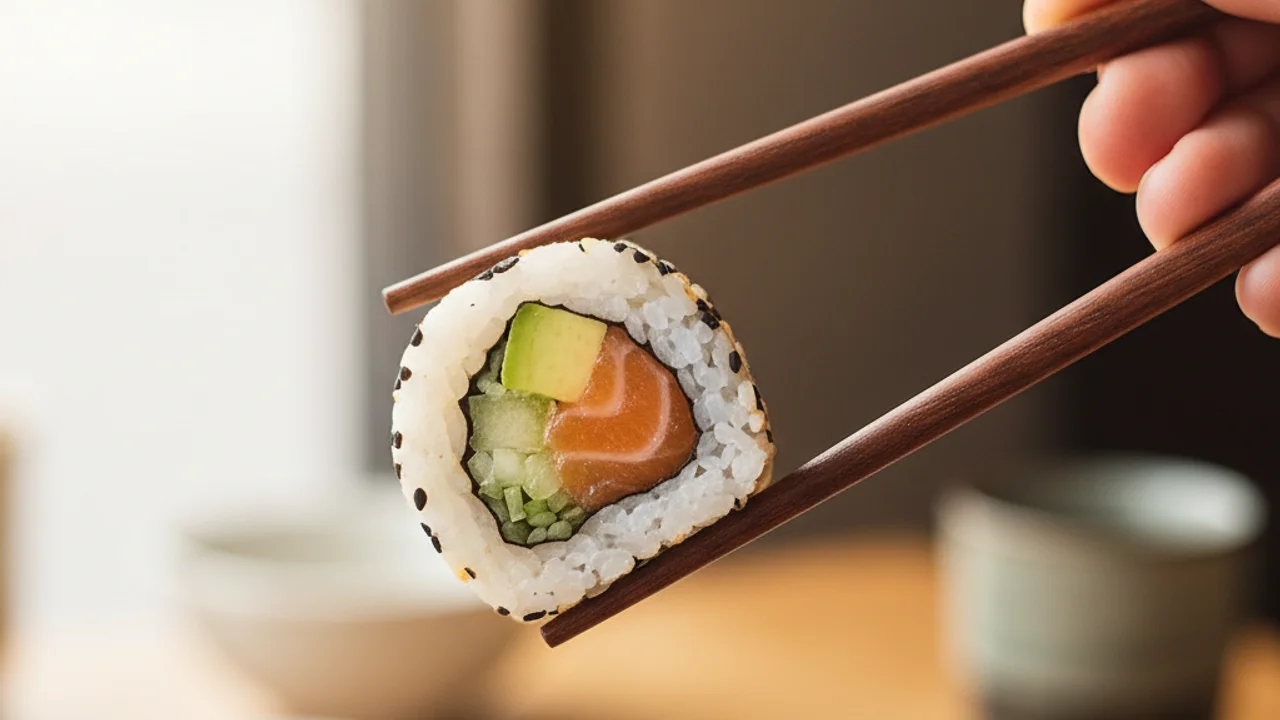
Chopstick etiquette is not about intimidating newcomers. It is about a set of gestures that carry meaning, accumulated over centuries, in a culture where the table is a place of care and attention. Understanding the reasoning behind the rules makes them easy to remember and easy to follow.
How to Hold Chopsticks
Hold the chopsticks in the upper third of their length, not in the middle and not at the very tip. The lower chopstick rests in the valley between your thumb and index finger, supported by the ring finger. It stays fixed. The upper chopstick rests between the tips of your index and middle fingers, controlled by the thumb. It moves.
The two sticks should meet cleanly at their tips when you close them, like tweezers. If they cross or one extends well past the other, adjust your grip higher. Parallel tips give you control; crossed tips give you frustration.
Practice the motion before you need to use them. The lower stick is the anchor; the upper stick does all the work. Squeeze the upper stick down to close, release to open.
Six Things Never to Do
1. Plant them upright in rice. Chopsticks standing vertical in a bowl of rice resemble the incense sticks burned at Buddhist funerals. It is a direct association with death and deeply inauspicious at any Japanese table.
2. Rub them together. Rubbing chopsticks implies they are rough, splinter-prone, and cheap. At a serious counter, they are not. If you have a genuine splinter, mention it to the staff.
3. Pass food chopstick to chopstick. This gesture mirrors the Buddhist funeral rite where bones are transferred from chopstick to chopstick during cremation. Place food directly on someone's plate instead.
4. Lick the tips. Licking chopsticks is considered unclean and bad-mannered at the table. If they need wiping, use your napkin discreetly.
5. Point with them. Gesturing toward someone or something with chopsticks in hand is impolite in Japanese culture, as it is with a fork in most Western contexts. Rest them if you need to gesture.
6. Hover indecisively over dishes (neburi-bashi). Moving chopsticks slowly over a spread of dishes without picking anything up is considered greedy and indecisive. Decide, pick up, eat.
How to Eat Sushi ProperlyDipping, ginger, ordering: the full guide to eating at the sushi counter.Why is it wrong to pass food from chopsticks to chopsticks?
Using Fingers for Nigiri
This surprises many first-time guests: eating nigiri with your fingers is not just acceptable, it is historically the correct way. Nigiri-zushi was invented as street food, picked up by hand and eaten in a single bite at a vendor's stall.
The rice in a well-made nigiri is pressed to hold its shape, but not so firmly that it becomes a brick. Your fingers can pick it up cleanly without it falling apart. Chopsticks, by contrast, can compress the rice unevenly or cause the piece to break mid-transfer.
The conventional method is to turn the nigiri over onto your fingers, fish side down, so when you dip it into soy sauce (if you choose to), only the fish meets the liquid. Then eat it in one bite, fish side against your tongue first.
The Chopstick Rest
A hashioki is the small chopstick rest placed at your setting. When you are not actively eating, set your chopsticks across it, tips to the left. Do not leave them crossed over each other on a plate; do not lean them against a dish; do not set them parallel across the rim of your bowl (that positioning is associated with the finished meal in some traditions).
The rest is a small gesture that keeps the counter clean and your chopsticks off the surface. It matters in a space where the counter is also the chef's workspace.
Why It Matters at a Serious Counter
None of these rules exist to exclude anyone. They exist because a sushi counter is a space where craft and attention are the defining values. The chef is working with the same level of care on every single piece. The gestures around the table are, in a small way, a response to that care.
At Aji, 929 St-Zotique Est, the counter has four seats. The distance between you and the chef is close enough to have a conversation in a normal voice. The etiquette is not rigid, but awareness is appreciated. Ask questions. Engage. Put the chopsticks down between pieces. That is all it takes.
Nigiri, Maki, Sashimi: What's the Difference?Nigiri is hand-pressed rice with fish on top; sashimi is fish alone; maki is rice and filling rolled in nori. Each format has its place.Sushi Glossary: 30 Words to Know at the CounterThirty essential sushi terms covering rice and vinegar, fish and toppings, technique, and counter etiquette, so you can follow the conversat- 1Hold chopsticks in the upper third, lower stick fixed, upper stick moving.
- 2Never plant chopsticks in rice, rub them together, or lick the tips.
- 3Never pass food chopstick to chopstick: it mirrors a funeral rite.
- 4Never point with chopsticks or hover indecisively over dishes.
- 5Fingers are perfectly correct for nigiri: it is the historical method.
- 6Rest chopsticks on the hashioki between every bite.
Etiquette at the sushi bar is simply awareness turned into habit. It comes naturally after a few visits, and no one expects perfection on the first one.
Ready to sit at the counter? Four seats. One evening you will not forget.
Make a reservation