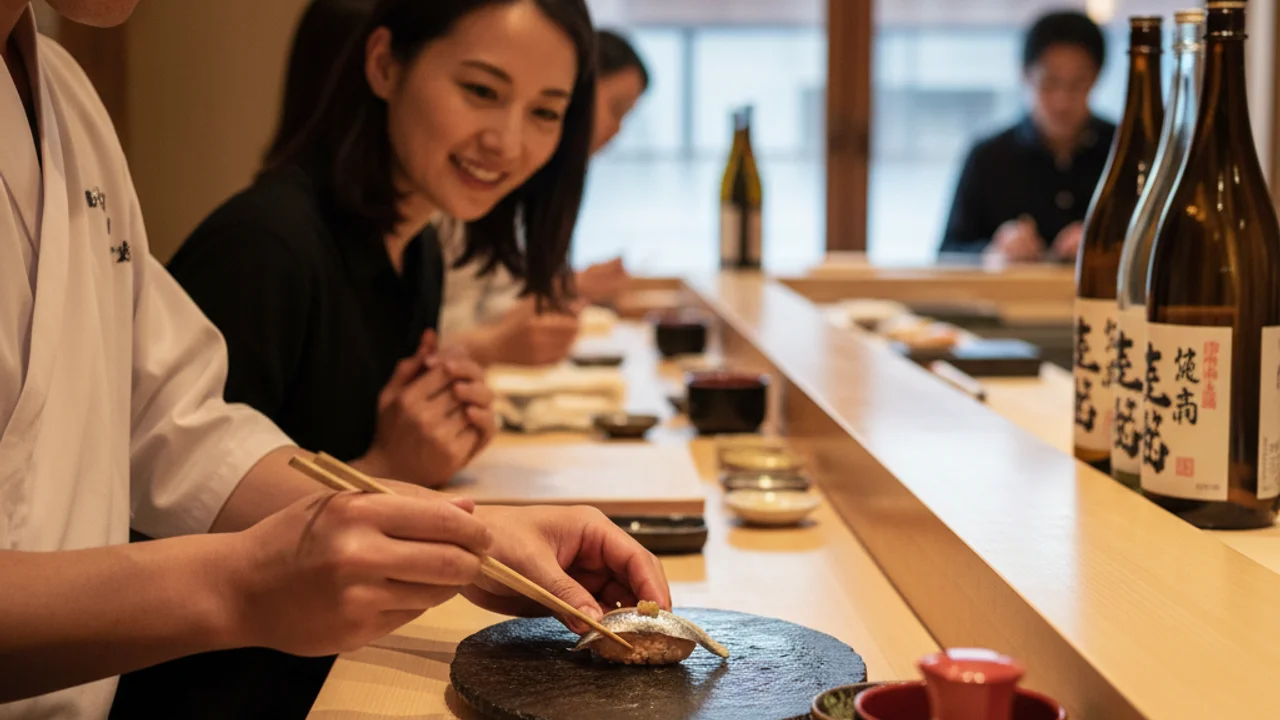
The best way to understand what an omakase counter experience feels like is to walk through one. What follows is a close description of a typical evening at Aji. The specific fish change with the season and the day's delivery, but the shape of the experience is consistent.
Arrival and the Setting
You arrive at 929 Saint-Zotique Est, a quiet stretch of Rosemont in the east end of Montréal. The entrance is understated. Inside, the counter runs across the room: four polished seats facing the open kitchen, with additional table seating where omakase is also served. There is no host stand, no elaborate lobby. You are simply close to where the cooking happens.
Guests are shown to their seats at the counter. The space is narrow enough that Chef Yamamoto can make eye contact with every guest without moving. That proximity is deliberate. It is the fundamental condition that makes the format work. The chef needs to be able to read the room, see how a piece landed, adjust the pace.
The evening opens with a quiet welcome and, usually, an explanation of the format for first-timers: omakase, no menu, roughly 90 minutes, between 12 and 18 pieces. If you brought a bottle, the team will open it and pour. Then the work begins.
The Opening Pieces
The meal typically opens with something delicate and clean. Hirame, flounder, is a frequent choice: the flesh is pale, almost transparent, with a fine texture and a flavour that rewards attention. The chef may serve it as sashimi, with just a brush of yuzu and a pinch of sea salt, or as a lightly seasoned nigiri placed directly on the counter in front of you.
This opening moment is intentional. The chef wants you focused and present before the more assertive flavours arrive. Starting with a strong fish would bury the subtler ones that follow. The sequence is a conversation with a structure, and the first line needs to be quiet enough that you lean in.
The next one or two pieces build on that foundation: perhaps madai, sea bream, or a seasonal white fish the chef received that morning. By the third or fourth piece, guests who arrived tense have usually settled into the pace.
What Is Omakase? Everything You Need to KnowThe format explained: how it works, what it costs, and how to prepare.The Nigiri Sequence
After the opening sashimi pieces, the chef moves into the heart of the sequence: nigiri, one by one. Each piece is pressed and placed in front of you in the same motion, the rice still warm, the fish at the temperature the chef judged correct for that specific cut.
The sequence deepens as it goes. From lean fish, hirame, madai, perhaps shima aji, the chef moves through medium-fat cuts, usually a Japanese amberjack or a seasonal mackerel, toward the richer territory of fatty tuna, or chutoro. Each piece is described briefly: the name, the origin if noteworthy, the technique applied.
Some pieces arrive already seasoned with nikiri, a reduced and softened soy sauce the chef applies with a brush. Those pieces need nothing added. Others arrive plain, and a small dish of soy sauce is within reach. The rule is simple: taste the piece first as it arrives, before reaching for anything.
In a classic omakase sequence, what type of fish is typically served first?
Conversation with Chef Yamamoto
One of the distinguishing qualities of the Aji counter is how naturally conversation happens. Chef Yamamoto does not lecture. He mentions what is worth mentioning: the name of the fish, where it came from, why he chose this particular cut tonight. Then he listens. If a guest has a question, he answers it. If the table is quiet, he lets the food speak.
Over thirty years of cooking, the chef has learned that the most valuable part of the counter format is not the food alone. It is the moment when a guest tries something unfamiliar and asks a real question about it. That exchange turns a meal into an education, and it happens most naturally in a room this size.
Do not feel obligated to make conversation, but do not hold back if you are curious. Ask what fish is currently in season. Ask why a piece arrives at a particular temperature. Ask about the rice. The chef chose this format because he wanted to be asked.
The Finale and the Ritual Close
As the sequence moves toward its end, the chef begins to introduce the richest pieces. Otoro, the fattiest belly of bluefin tuna, has a flavour that is simultaneously intense and melting. Uni, sea urchin, brings an oceanic richness that most guests describe as unlike anything else. Anago, salt-water eel, glazed lightly and served warm, often closes the savoury sequence with a quiet and satisfying sweetness.
The very last piece is frequently a tamagoyaki, the chef's egg omelette, cooked slowly in a rectangular pan. In the edomae tradition, tamagoyaki is a marker of skill: it is technically demanding and entirely unforgiving. A well-made tamagoyaki at the end of a meal signals that the chef has nothing to hide, including in the simplest preparations.
After the last piece, the meal is complete. There is no dessert course in the Western sense, though the team may offer something small and sweet, a piece of fruit, a small confection, depending on the evening. The close is calm, never hurried. Guests are welcome to linger over their wine before leaving.
First-Time Omakase Guide: How to PrepareEverything a first-timer needs to know before sitting at an omakase counter.Celebrating a Birthday at a Japanese RestaurantAn omakase at Aji makes an exceptional birthday gift: it is an experience, not a plate. Book early, mention the occasion, bring wine, and leBooking Online: The Floor Plan and the Four-Seat CounterThe reserve page shows a visual floor plan, real-time availability, and every seat, including the four counter seats.- 1Arrive on time: the counter serves all guests in sequence, and late arrivals disrupt the rhythm.
- 2The meal opens with delicate white fish and builds toward rich pieces like otoro, uni, and eel.
- 3Each piece is described by the chef: listen, then eat it within a minute of receiving it.
- 4Conversation with Chef Yamamoto is welcome and natural: curiosity is part of the format.
- 5The ritual close, often a tamagoyaki, signals the end of the savoury sequence.
Experience the Aji counter for yourself. 929 St-Zotique Est, Montréal. Tel. 514 272 2929.
Make a reservation