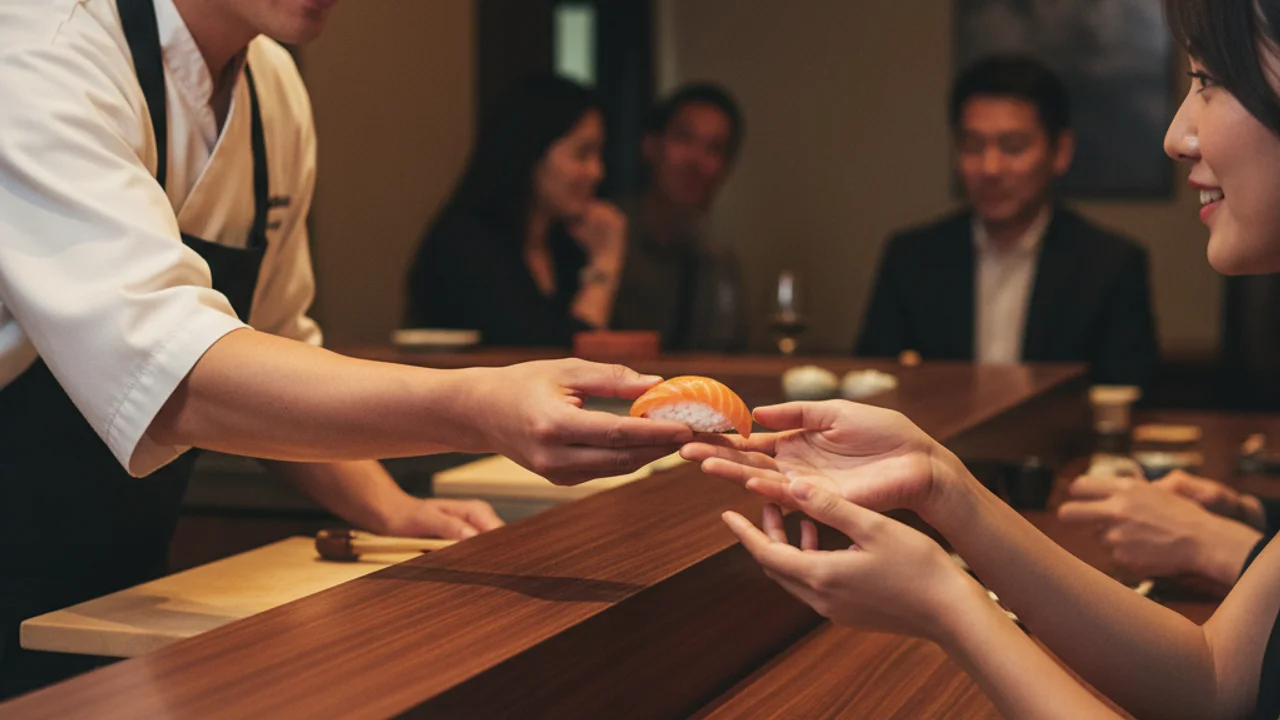
At most restaurants, you decide what you eat. At an omakase counter, you decide who you trust. That distinction sounds simple, but it changes everything, from the atmosphere to the way you approach each bite.
What omakase means
The word comes from the Japanese verb makaseru (任せる): to entrust, to delegate, to place in someone's hands. The honourific phrase omakase shimasu is what a guest says to an itamae, a counter chef, to signal: compose this meal for me.
It is not an invitation for the chef to show off or to surprise at all costs. It is a relationship of trust in which the chef puts his judgment in service of your enjoyment. He knows what arrived this morning, what is at the peak of its form today, what deserves to be served, and in what order.
How a session unfolds
Everything begins at arrival. The chef or a team member welcomes you, offers a drink, and notes your dietary restrictions, aversions, and any strong preferences. That exchange rarely takes more than two minutes, but it shapes the entire sequence.
The meal opens with light pieces: delicate white fish, clean, fresh preparations. The chef progresses toward more intense flavours, fattier cuts, bolder bites, sometimes a warm course or a small broth, before closing on a sweet or calming note. Each piece is placed directly in front of you, with a brief explanation when the chef feels it adds to the experience.
The pace is set by the chef, not by your hunger. You do not order extra pieces mid-meal. If you are still hungry at the end, it is perfectly acceptable to say so, and the chef can add a few pieces depending on what remains available.
Omakase Counter Etiquette: 10 Simple RulesThe gestures that make the experience better for everyone at the counter.Cost and duration
An omakase session typically runs 75 to 120 minutes. It is an unhurried meal, but not an interminable one. At Aji, allow about 90 minutes to enjoy each piece without feeling rushed.
Pricing reflects the quality of the ingredients, the number of pieces, and the local market. In Montréal, a well-sourced omakase counter sits within a reasonable range for a gastronomic meal. What you are paying for is as much the chef's judgment, the mise-en-scene, and the time he spends working in front of you, as it is the raw ingredients themselves.
Talking with the chef
Omakase is not a silent meal. The counter is designed for proximity, and that proximity invites exchange. You can ask where tonight's tuna came from, why the chef chose this fish over another, how he aged a particular cut. These questions are welcome, not intrusive: they feed the experience as much as the bites do.
The one thing to watch is timing. Let the chef complete a technique before engaging. A pause in the work, a moment of eye contact: that is the signal the conversation is available. He will do the same with you.
What does the word 'omakase' mean in Japanese?
Omakase at Aji's 4-seat counter
Aji Bar Sushi & Izakaya MTL's counter holds four seats arranged directly facing Chef Yamamoto's work station. That configuration is not an aesthetic choice: it ensures every guest sees every cut, every seasoning, every gesture. The experience is intimate and collective at once.
Chef Yamamoto composes his sequence according to the week's deliveries, the season, and the sensibility of the guests in front of him. No two evenings are exactly alike. That is the nature of omakase: a living meal, rooted in the present moment.
Your First Omakase: The Complete GuideHow to prepare, what to do, what to avoid, and how to taste each piece.Kaiseki vs. Omakase: Two Philosophies of Japanese DiningKaiseki is a formal multi-course meal rooted in Kyoto's tea ceremony tradition, with a fixed sequence and elegant tableware. Omakase is a coOmakase, Reinvented: All the Pleasure, None of the Hungry WaitAt Aji, omakase is an option, not an obligation. We start as a sushi & izakaya counter (Japanese tapas), and omakase happens at the counter- 1Omakase means 'I leave it to you': it is an act of trust toward the chef.
- 2The session moves from lightest to most intense, typically 12 to 20 pieces over 75 to 120 minutes.
- 3Mention dietary restrictions at booking, not on arrival.
- 4Conversation with the chef is welcome and enriches the experience.
- 5At Aji, 4 seats at the counter and Chef Yamamoto working directly in front of you.
Omakase asks very little of you in terms of preparation. The essentials: arrive hungry, arrive curious, and be ready to be guided. The chef handles the rest.
Ready to experience omakase at Aji's counter?
Make a reservation