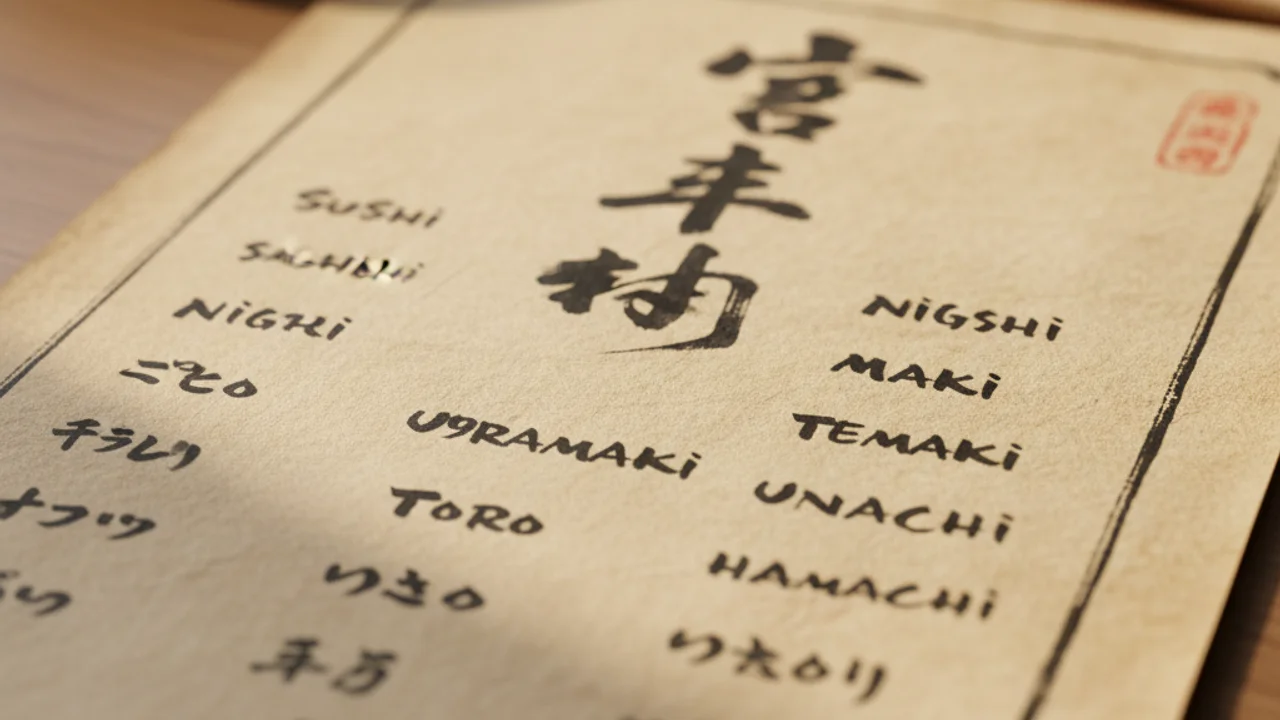
Walking up to a sushi counter for the first time can feel like arriving in a city where you do not speak the language. The menu uses Japanese terms, the chef describes things you have never heard, and the ritual moves quickly. These thirty words will not make you an expert, but they will make you comfortable.
Rice and Vinegar
Shari is the vinegared rice that forms the base of every sushi. It is seasoned with a mixture of vinegar, sugar, and salt, and served at approximately body temperature. The word technically means "sacred relic" in Sanskrit, which tells you how chefs regard it.
Awasezu is the vinegar seasoning mixture blended into the cooked rice to make shari. It combines rice vinegar, sugar, and salt in proportions that vary by chef.
Akazu is red vinegar, made from sake lees (the solids left after brewing sake). It gives shari a warm beige colour and a deeper, more complex umami than white rice vinegar. It is the traditional vinegar of edomae sushi.
Hangiri is the wide, flat wooden tub, usually made from cypress, in which the chef mixes hot rice with awasezu. The wood absorbs excess moisture and gives the shari its characteristic sheen.
Koshihikari is the short-grain Japanese rice variety most commonly used for shari. It has a natural sweetness, a slight stickiness, and the structural integrity to hold its shape when hand-pressed.
Fish and Toppings
Neta is the topping placed on the shari in a nigiri: typically a slice of fish or seafood. When a chef refers to the neta, they mean the fish component specifically.
Maguro is bluefin tuna. It is divided into grades: akami (lean, deep red), chutoro (medium fatty), and otoro (the richest, most marbled cut from the belly).
Otoro is the fattiest cut of bluefin tuna, from the belly near the head. It melts at body temperature and carries the highest concentration of fat and flavour. It is almost always the most expensive piece on the counter.
Uni is sea urchin roe, the orange or yellow tongues harvested from the urchin's shell. Quality varies enormously by season and origin. Good uni has a clean, oceanic sweetness; poor uni tastes bitter and metallic.
Ikura are salmon roe. The individual spheres are large, glistening, and burst with a clean brine when bitten. They are typically served as gunkan.
Gari is thinly sliced pickled ginger. It is a palate cleanser, eaten between pieces, never placed on top of a sushi.
Kohada is gizzard shad, one of the most iconic edomae fish. It is cured in salt and vinegar, a preparation that transforms its raw, oily flavour into something delicate and complex. Skill with kohada is considered a measure of an edomae chef's craft.
Tai is sea bream. Lean, firm-fleshed, and subtly flavoured, it is often the first piece in an omakase sequence. It ages particularly well under controlled refrigeration.
Nigiri, Maki, Sashimi: What's the Difference?A clear breakdown of every sushi format and when to order each.Technique
Zuke is a marinating technique where fish, most often tuna, is submerged in soy sauce for a period of time. It was an edomae preservation method before refrigeration. Today it adds depth and umami to the fish intentionally.
Shimesaba refers to mackerel cured in salt and rice vinegar. The process firms the flesh and transforms the fish's character. It is a foundational edomae technique.
Nekase is the controlled aging of fish under refrigeration, allowing enzymatic breakdown to develop umami and tenderness. Not all fish age well; knowing which ones to age and for how long is a key part of edomae knowledge.
Nikiri is a seasoned soy sauce the chef brushes directly onto a piece before serving it. When you see a gleaming surface on a nigiri, it has been nikiri-finished. You do not need the soy dish.
Tsume is a sweet, reduced sauce made from eel cooking liquid, soy, and mirin. It is the glaze brushed onto anago (saltwater eel) and sometimes unagi (freshwater eel).
Katsuobushi are thin shavings of dried, fermented, smoked tuna (bonito). They are the base of dashi broth but appear on sushi menus as a topping or a flavour component.
What does 'nikiri' mean in a sushi context?
Etiquette and Service
Omakase means "I leave it to you" in Japanese. Ordering omakase means trusting the chef to select, prepare, and sequence every piece. It is the highest form of engagement at a sushi counter.
Itamae is the term for the sushi chef who works on the other side of the counter from you. Literally "in front of the cutting board," itamae designates the trained professional overseeing each piece.
Agari is the term for green tea at a sushi counter. It is the final tea served at the end of a meal, signalling the close of the experience. In some traditions it is the only tea offered.
Murasaki is the counter term for soy sauce. Using the counter vocabulary, even if only the words you know, is a small sign of respect toward the craft.
Toro is the fatty section of tuna. When a chef says "toro," they typically mean either chutoro or otoro, often clarifying which. Akami is the lean cut and is not called toro.
Sushi Formats
Nigiri-zushi is the full name for hand-pressed sushi: rice formed by hand with a topping placed on top.
Gunkan is the battleship form: nori wrapped around rice to create a cup for loose toppings like uni or ikura.
Maki is a rolled sushi with nori on the outside, rice and filling inside, cut into rounds.
Uramaki is the inside-out roll: rice outside, nori and filling inside.
Temaki is a hand roll formed into a nori cone, meant to be eaten immediately.
Sashimi is fish or seafood without rice, served alone. Technically not sushi.
Chirashi is a bowl of shari topped with a varied selection of fish and garnishes. Less formal than nigiri, and more abundant.
Chopstick Etiquette at the Sushi BarHold chopsticks near the top third, rest them between bites, and never plant, rub, point, pass food with, or lick them. For nigiri, fingers- 1Shari is the vinegared rice: the foundation of all sushi, half the work.
- 2Akazu is red vinegar from sake lees: the traditional choice for edomae shari.
- 3Neta is the topping; together with shari it forms a nigiri.
- 4Nikiri is the chef's soy glaze on the fish: when you see it, skip the dipping dish.
- 5Omakase means trusting the chef entirely: sequence, format, and portion.
- 6Gari is a palate cleanser between pieces, not a topping or condiment.
A glossary is a starting point, not a destination. The best way to internalize these words is to sit at the counter and use them in context, one piece at a time.
Put the vocabulary to work at the Aji counter, 929 St-Zotique Est, Montréal.
Make a reservation