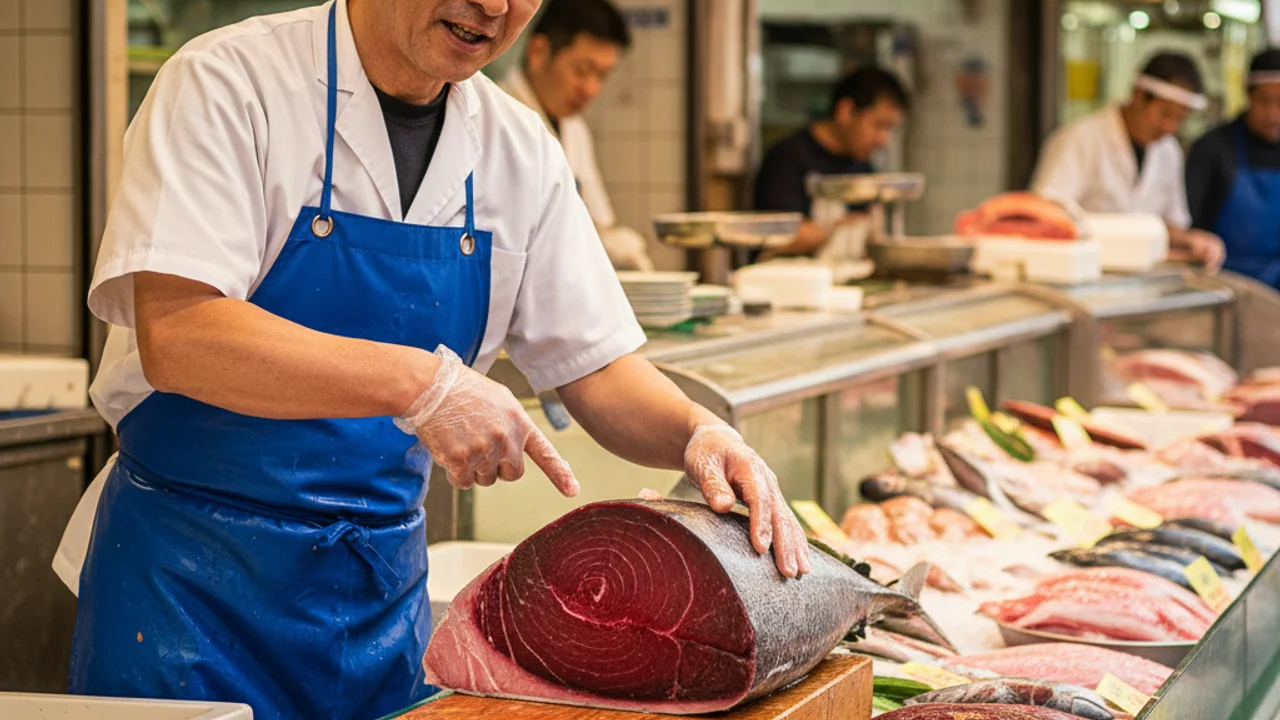
On an omakase menu, the word "tuna" covers far more than one fish. The same meal can move through a clean, precise akami, a silky chutoro, and a dissolving otoro, all from the same animal but from radically different parts of it. Alongside bluefin, a well-sourced yellowfin or bigeye can be genuinely surprising. Here is how to tell them apart and what to expect from each.
Bluefin Tuna: Hon-Maguro
Pacific bluefin (Thunnus orientalis) and Atlantic bluefin (Thunnus thynnus) are the reference species of the sushi tradition. In Japanese, the name is hon-maguro, meaning "true tuna," a designation that signals how central this fish is to the craft.
What distinguishes bluefin from every other tuna species is its fat content. A mature bluefin that has spent winter months in cold water accumulates significant intramuscular fat reserves. This fat gives the flesh a deep red-to-crimson colour, a supple, almost yielding texture, and a rich, long-finishing flavour that is closer to well-marbled beef than to the clean brightness people associate with "fish."
The Cuts: Akami, Chutoro, Otoro
The body of a bluefin tuna is not uniform. Fat content varies considerably across the fish, producing three distinct cuts with very different flavour profiles and prices.
Akami. The dorsal muscle, lean at roughly 1.5 percent fat. Bright red, firm, clean in flavour. The most common tuna cut in sushi and often the least understood: a quality akami from a well-handled bluefin has a depth that mediocre versions entirely lack. This is a technical cut as much as an ingredient.
Chutoro. The medium-fatty cut, taken from the flanks and mid-belly, with roughly 15 to 20 percent fat. Marbled flesh, colour between red and pink, texture between the firmness of akami and the softness of otoro. Many seasoned diners consider chutoro the most satisfying of the three: it combines both dimensions.
Otoro. The fattiest portion of the anterior belly, sometimes exceeding 25 to 30 percent fat. Pink-to-white, traversed by visible fat lines. It dissolves on the palate before you have time to chew. The most expensive and most dramatic cut, but also the one that fatigues the palate fastest: one or two pieces is the right amount.
Seasonal Fish in Japanese Cuisine: The Concept of ShunWhen bluefin tuna is at its peak, and how the season shapes what Aji serves.Which cut of bluefin tuna has the highest fat content?
Yellowfin Tuna: Kihada
Yellowfin (Thunnus albacares), called kihada in Japanese, is a fundamentally different eating experience. The flesh is lighter in colour, ranging from pink to light red, much firmer, and far leaner than bluefin. The flavour is clean, direct, with a mild sweetness.
Yellowfin does not produce otoro or chutoro: the fat content is too low. That is not a flaw. A properly sourced yellowfin, cut at the right thickness and placed on well-made shari, has a brightness and clarity of flavour that a very fatty bluefin cut cannot offer. The two fish serve different purposes on the menu.
Yellowfin is also generally more available and less expensive than bluefin, making it a practical choice for restaurants that want to maintain consistent quality without depending on the irregular arrivals of prime bluefin.
Bigeye: Between the Two
Bigeye tuna (Thunnus obesus), or mebachi in Japanese, occupies the middle ground. Its flesh is darker than yellowfin, fattier, and often used as a serious alternative to bluefin for mid-range tuna cuts. At its best, bigeye offers much of the richness of chutoro at a lower cost and with greater availability.
In North America, "red tuna" in grocery stores or general restaurants often refers to bigeye or yellowfin rather than true bluefin. If you want hon-maguro specifically, always ask the chef for the exact species. At Aji, the team names the fish.
Sustainability and Seasonality
Atlantic bluefin was subject to strict quotas for decades due to overfishing. Populations have partially recovered, but pressure remains. Pacific bluefin is also under monitoring. Some fisheries are certified sustainable, but traceability remains complex across the supply chain.
Yellowfin and bigeye are generally considered more sustainable options, though practices vary by region and fishing method. Pole-and-line or handline fishing carries a lower bycatch impact than longlines.
In terms of season, Atlantic bluefin is at its best in late fall and early winter, when it has built up its fat reserves. Pacific bluefin follows a slightly different calendar. At Aji, the arrival drives the menu: tuna is served when it is remarkable, not as a permanent fixture.
Fresh vs. Frozen Fish for Sushi: The TruthFood safety regulations, flash-freezing at minus 60 degrees, and the myth that fresh is always better.Uni, Ikura, Tobiko: The Delicacies of the Sushi CounterUni is sea urchin gonads, prized for their oceanic sweetness. Ikura is cured salmon roe, salty and bursting. Tobiko is flying fish roe, tobi- 1Bluefin tuna (hon-maguro) yields three cuts: akami (lean), chutoro (medium fat), and otoro (very fatty).
- 2Yellowfin (kihada) is leaner, firmer, and brighter in flavour than bluefin.
- 3Bigeye (mebachi) sits between the two and is often used as a bluefin alternative.
- 4Otoro is the most dissolving and most expensive cut: one or two pieces is the right amount.
- 5Sustainability varies by species and source: always ask your chef for provenance.
Next time you sit at the counter, ask what tuna is on the menu that day. The answer tells you more about a restaurant's philosophy than any fixed menu card ever could.
Come see what the counter has today. Arrivals guide the menu at Aji.
Make a reservation