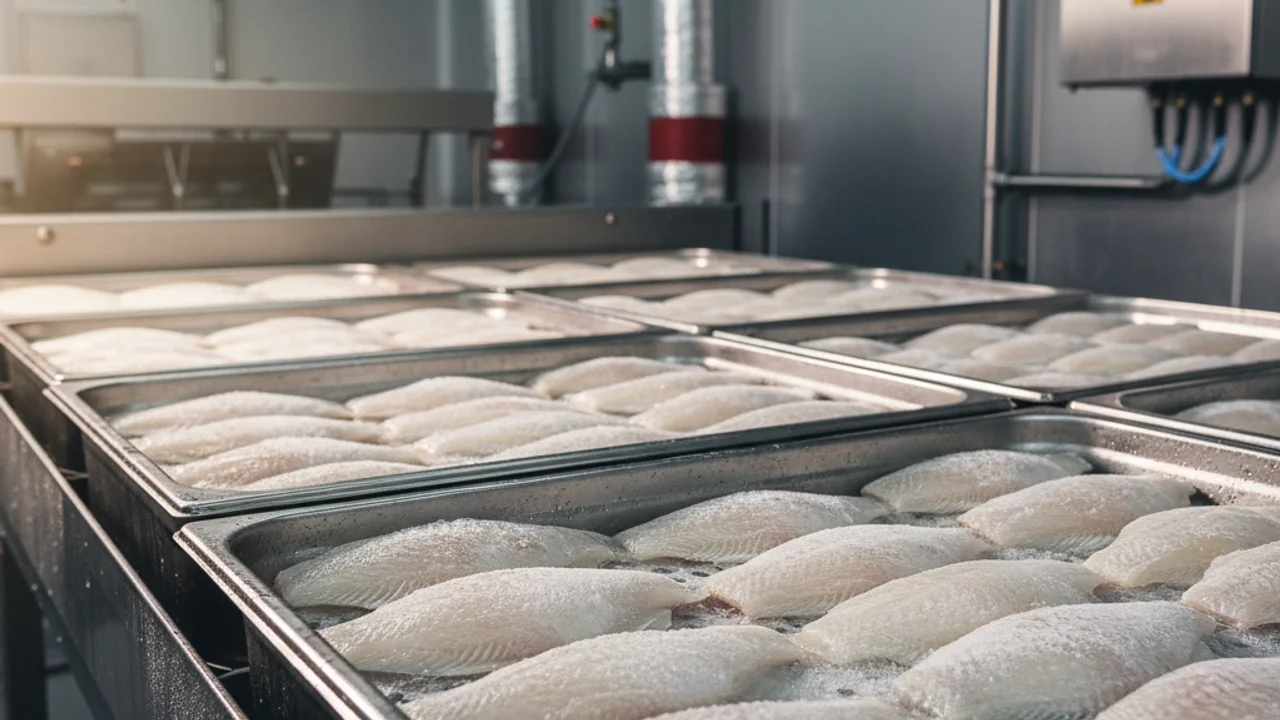
The assumption is almost universal: fresh is better. At the fish counter, at the sushi bar, in the restaurant review. Fresh, never frozen. In the context of sushi, this assumption is not just oversimplified. In many cases, it is wrong. Understanding why requires a brief look at food safety regulations, the science of freezing, and the reality of fish handling across the supply chain.
Food Safety Regulations
Health Canada's guidelines and Canadian Food Inspection Agency standards recommend that fish intended for raw consumption be frozen to eliminate parasites. The specific requirements vary by species and province, but the principle is consistent: wild-caught fish like salmon, tuna, and mackerel carry a risk of parasitic infection (most commonly Anisakis worms) that freezing reliably eliminates.
The required temperature parameters are specific. A short hold at a standard freezer temperature is not sufficient. Effective parasite elimination requires either minus 20 degrees Celsius for at least seven days, or the faster and more effective method: blast-freezing at minus 35 degrees Celsius or below for 15 hours, or holding at minus 35 for 24 hours.
The "Sushi-Grade" Myth
"Sushi-grade" appears on packaging at fish counters and in restaurant menus. It sounds regulated. It is not. In Canada and the United States, no government body certifies or defines "sushi-grade." Any supplier can print the words on a label.
In practice, a responsible supplier using "sushi-grade" on their packaging typically means the fish has been blast-frozen to parasite-killing temperatures and handled under strict cold-chain conditions. But there is no third-party verification and no legal standard enforcing the claim. The only protection is the reputation and transparency of your supplier and your restaurant.
Bluefin vs. Yellowfin Tuna: What's the Difference?How species, fat content, and sourcing affect quality at the sushi counter.What does 'sushi-grade' mean in the context of Canadian food labelling?
Flash-Freezing: The Science
The texture damage associated with frozen fish comes from slow freezing. When fish freezes slowly, water molecules form large ice crystals that pierce cell walls, breaking down the cellular structure of the flesh. The result when thawed is a mushy, weeping texture.
Blast-freezing at minus 60 degrees Celsius changes this entirely. At these temperatures, freezing happens so rapidly that ice crystals form as very small particles, causing minimal cell damage. A piece of tuna that has been properly blast-frozen and then carefully thawed is virtually indistinguishable in texture from never-frozen fish. In some cases, because the blast-freezing halts enzymatic degradation, it can be better.
This is why Japanese sushi culture has never been ideologically opposed to freezing. The Edomae tradition values precision over sentimentality. If the best way to handle a specific fish involves freezing, the best sushi chefs freeze it.
When Truly Fresh Fish Is Used
There are cases where fish is legitimately served raw without any freezing step. Farmed salmon raised in parasite-controlled, closed aquaculture environments may qualify, provided the farm's biosecurity standards are verified. Live shellfish, oysters, and surf clams are served fresh because parasitic risk is different for bivalves.
In Japan, certain fish processed through ikejime (a method of immediate neural spiking that arrests rigor and preserves quality) and delivered with verifiable same-day handling can be served without prior freezing in licensed establishments. This is a narrow, controlled exception that requires full traceability from the boat to the counter.
These scenarios represent the minority of what a sushi restaurant handles. For the vast majority of species, wild-caught and otherwise, the responsible answer involves a freezing step somewhere in the chain.
How Aji Handles Its Fish
At Aji, fish is sourced from suppliers who handle cold-chain and freezing requirements as part of their standard practice. The team does not make decisions about handling based on perceived consumer preference for "fresh": the decision is based on food safety and the actual quality of the fish on arrival.
If you are curious about a specific piece, ask at the counter. The team will tell you where it came from, how it was processed, and what drove the decision to serve it that day. This is the standard we hold for every ingredient on the menu.
Seasonal Fish in Japanese Cuisine: The Concept of ShunHow peak season drives flavour and why eating in season means better fish.Uni, Ikura, Tobiko: The Delicacies of the Sushi CounterUni is sea urchin gonads, prized for their oceanic sweetness. Ikura is cured salmon roe, salty and bursting. Tobiko is flying fish roe, tobi- 1Health Canada recommends freezing wild-caught fish intended for raw consumption to eliminate parasites.
- 2'Sushi-grade' is not a regulated term in Canada: it carries no legal guarantee.
- 3Blast-freezing at minus 60 degrees Celsius preserves cellular structure and texture effectively.
- 4Truly never-frozen fish is used only in specific, controlled contexts: farmed salmon, live shellfish, or verifiable ikejime handling.
- 5Ask your chef about provenance and handling: transparency is the real quality indicator.
The next time you read "fresh never-frozen" on a sushi menu, do not assume it is a mark of quality. Ask what it means in practice. At Aji, the answer to that question is always available.
Curious about the fish we serve? Come to the counter and ask. We know where every piece comes from.
Make a reservation