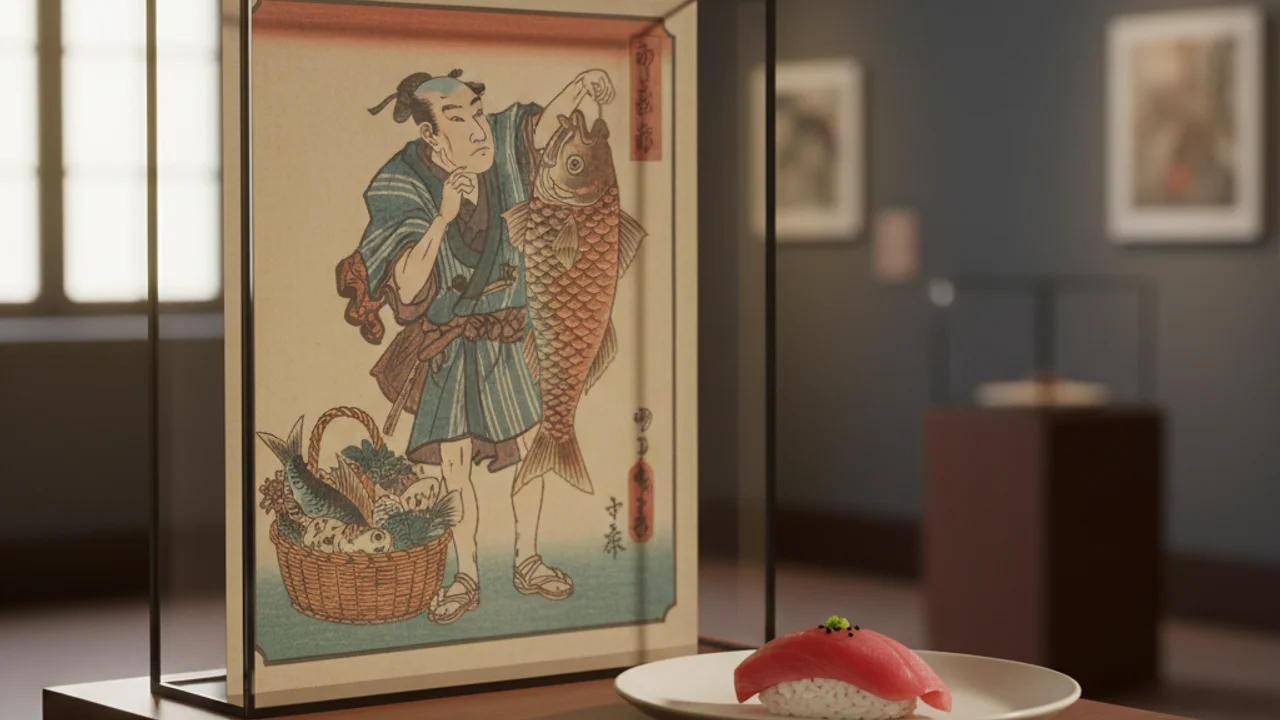
When people describe sushi as "traditional," they usually have only a vague sense of what that means. Edomae is a specific thing: a style, a set of techniques, and a philosophy rooted in a particular time and place. Understanding where it came from is the best way to understand why it tastes the way it does.
Edo: Where It Began
In the early 19th century, Edo was one of the most densely populated cities on earth, home to well over a million people. The bay in front of the city, Edo Bay, was extraordinarily productive: fishermen delivered their catch each morning to the markets of Nihonbashi, and the streets were full of vendors selling fast, affordable food to a working urban population.
It was in this environment that nigiri-zushi appeared, around the 1820s. The invention is most often attributed to a chef named Hanaya Yohei. The idea was simple and revolutionary at once: press seasoned rice into a small oblong shape with the hands, lay a prepared piece of fish on top, and serve it immediately. One bite, complete in itself.
The name "edomae" is geographical: it means "in front of Edo," pointing directly to the bay and the fish it provided. This was a cuisine of immediate locality. What swam in the bay in the morning could be on the counter by midday.
The Original Preservation Techniques
Without refrigeration, the chefs of 19th-century Edo developed ingenious methods to prepare, preserve, and enhance their fish. These techniques are not a workaround for the lack of cold storage: they are flavour transformations in their own right, and they define what edomae is.
Zuke is the practice of marinating tuna in soy sauce. The fish absorbs the salt and amino acids of the soy, deepening its umami and extending its shelf life by a day or two. Zuke tuna was one of the most popular nigiri in Edo; it remains a classic.
Shimesaba is the curing of mackerel in salt and rice vinegar. Mackerel spoils rapidly; the salt firms the flesh and the vinegar transforms its character. The resulting fish is denser, more complex, and utterly different from raw mackerel. It is one of the signature preparations of the edomae kitchen.
Kohada, the gizzard shad, required the most precise handling of all. This small, oily fish was marinated in vinegar with careful timing: too short and it remained harsh; too long and it became unpleasantly acidic. Mastery of kohada was, and still is, considered a marker of an edomae chef's overall skill.
Gentle cooking was applied to shellfish and crustaceans: shrimp poached to just-done, octopus simmered long and slowly in sake and soy, eel grilled and lacquered with tsume. These preparations held for hours and allowed the chef to offer variety throughout the service.
Fish Aging in Japanese Cuisine: Why It MattersThe science and craft behind controlled fish aging, and which species benefit most.From Street Food to Counter Art
For its first decades, edomae sushi was entirely accessible: cheap, quick, sold from yatai stalls in the streets of Edo. A nigiri cost a few sen, the smallest denomination of currency. The stalls multiplied. The form spread.
The transformation began at the turn of the 20th century. Modernization, disasters such as the 1923 Great Kanto Earthquake, and accelerating urbanization pushed street vendors indoors. Stalls became restaurants. Restaurants built counters. Counters attracted more discerning and more prosperous clientele.
The introduction of mechanical refrigeration in the 1940s and 1950s changed the equation dramatically. Raw, unprocessed fish became viable. The techniques that had been essential for preservation began to look archaic to a younger generation of chefs. The global wave of modern sushi, dominated by raw fish without preparation, took hold through the second half of the 20th century.
But some chefs refused the erasure. In Japan and, eventually, in cities abroad, a small number of itamae kept the edomae techniques alive and folded them into the possibilities of modern refrigeration: controlled aging, precision curing, intentional zuke. Contemporary edomae is both a continuity and an evolution.
What does 'edomae' literally mean in Japanese?
Edomae and Modern Sushi: The Differences
The most visible difference is in the rice. Traditional edomae shari is made with red vinegar (akazu), pressed from sake lees, which gives the rice a warm beige tone and a noticeably richer umami. Modern sushi almost universally uses white rice vinegar, which is neutral in colour and simpler in flavour.
The second difference is fish treatment. Modern sushi emphasizes raw freshness, presented without intervention. Edomae, historically and in its contemporary practice, always involves a preparation step: aging, curing, marinating, or cooking. The fish is transformed, not merely sliced.
The third difference is the experience itself. Edomae at the counter is a sequence, a narration built piece by piece, in dialogue with a single guest or a small group. Modern sushi is often a menu to be ordered from, consumed in whatever order the customer chooses. Edomae values the arc, the progression, the intention behind each placement.
Aji and the Edomae Tradition in Montréal
Practising edomae in Montréal requires adaptation. The fish of Edo Bay are not available here. But the principles travel: rigour in fish preparation, quality of the shari, precision of the gesture, attentiveness to the guest. The philosophy survives a change of geography.
At Aji Bar Sushi & Izakaya MTL, 929 St-Zotique Est, the counter holds four seats, and the reinvented omakase is also served at the tables. The chef works every product according to what is in season and what has arrived. Some fish are aged for two or three days before service. The rice is cooked and seasoned each evening, never held over. Red vinegar is part of the shari formula.
The edomae tradition is not a brand or a marketing claim. It is a set of daily decisions: about sourcing, preparation, temperature, timing. Those decisions are what make each piece at the counter different from what you find elsewhere.
Shari: The Rice That Makes or Breaks Your SushiShari is the vinegared rice at the heart of every sushi. Its variety, vinegar blend, temperature, and preparation determine the quality of a- 1Edomae sushi was born in 19th-century Edo (Tokyo) as affordable street food.
- 2Its defining techniques: zuke (soy marinade), shimesaba (vinegar cure), and kohada preparation.
- 3Refrigeration marginalized these techniques in the 20th century, but some chefs kept them alive.
- 4Edomae is distinguished by red vinegar shari and the deliberate preparation of every fish.
- 5At Aji in Montréal, the edomae tradition is practised daily: aged fish, akazu rice, nikiri service.
The history of edomae sushi is the history of a simple idea made profound by two centuries of refinement. Sitting at the counter is a way of participating in that continuity.
Experience the edomae tradition at the Aji counter, 929 St-Zotique Est, Montréal.
Make a reservation