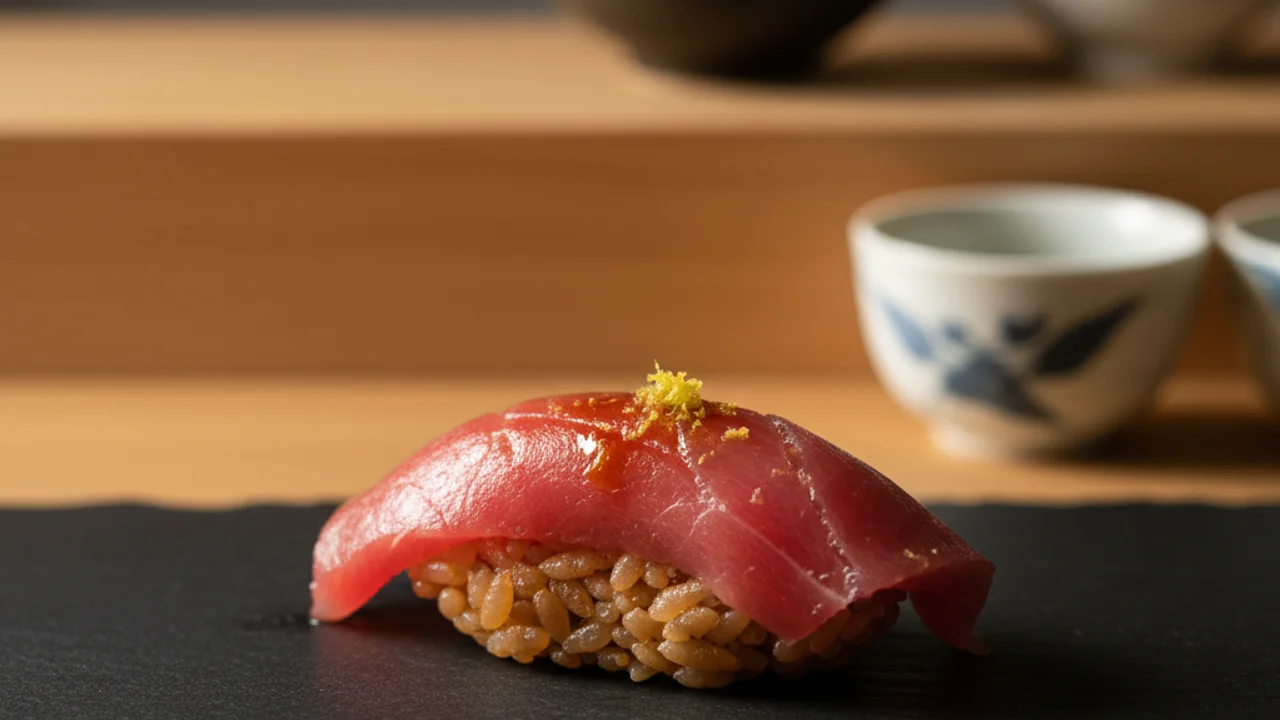
When you sit at the counter at Aji and pick up a nigiri, you may notice that the rice is not white. It is a warm, pale amber, faintly earthy in tone. That colour is the first visible sign of akazu: a vinegar that most sushi restaurants in the world have never used, and that defines the rice of the edomae tradition as distinctly as the fish placed on top.
What Akazu Is
Akazu means "red vinegar" in Japanese. The name refers to its colour, a warm amber that ranges from pale gold to deep russet depending on how long it has been aged and what percentage of sake lees it contains. It is one of the oldest vinegar traditions in Japan, predating the widespread use of rice vinegar by several centuries.
Its raw material is sake kasu: the lees, or pressed solid residue, that remain after sake has been fermented and separated from the liquid. Sake kasu is rich in proteins, amino acids, and yeast cells. Most sake producers once sold or discarded it as a byproduct. A smaller number of vinegar producers saw its potential as a fermentation substrate.
The result, after extended aging, is a vinegar unlike anything produced from grain alone. Its character comes from the accumulated complexity of the sake fermentation plus the secondary acetic acid fermentation that transforms it into vinegar.
How It Is Made
The production of akazu begins with fresh sake kasu. The lees are mixed with water, sometimes with the addition of older vinegar to seed the fermentation, and left to ferment under acetic acid bacteria. This initial conversion of alcohol to acetic acid takes weeks.
The resulting liquid is then aged, typically in ceramic crocks or wooden vats, for anywhere from six months to several years. During this aging period, enzymatic activity continues: proteins from the sake lees break down further into free amino acids, melanoidins (complex browning compounds) develop and deepen the colour, and the acidity rounds and softens.
The final product is filtered and bottled, though high-quality akazu retains a slight cloudiness that attests to its minimal processing. The extended production timeline and the specialized raw material make akazu considerably more expensive per litre than commercial white rice vinegar.
Akazu vs. White Rice Vinegar
White rice vinegar is made from fermented rice, filtered, and produced at industrial scale. It is clean, bright, and relatively neutral: a functional acid that seasons shari without adding complexity of its own. That neutrality is often a feature in modern sushi, where the chef wants the fish to do all the speaking.
Akazu is the opposite of neutral. Its amino acid content, particularly glutamic acid, is many times higher than that of white rice vinegar. This means that when it is blended into shari, the rice itself carries a significant umami load, independent of the fish. The rice becomes an active flavour element rather than a neutral base.
The acidity of akazu is also structurally different. White vinegar delivers a sharp, clean tartness that dissipates quickly. Akazu has a longer, rounder finish, more complex on the palate and less aggressive on the throat. A well-made akazu shari is seasoned without tasting aggressively sour.
The colour difference is the most immediately visible signal: akazu shari is beige to amber, warm and earthy in tone. White vinegar shari is stark white. If you see warm-toned rice at a sushi counter, you are looking at an edomae kitchen.
Shari: The Rice That Makes or Breaks Your SushiThe full picture of how sushi rice is made, from variety to temperature to vinegar.What is the raw material from which akazu (red vinegar) is produced?
The Post-War Decline
Before World War II, akazu was the standard vinegar for shari in the major sushi cities of Japan. The edomae counters of Tokyo and the surrounding region used it as a matter of course. Its umami, colour, and rounded acidity were simply what good sushi rice tasted like.
The war changed everything. Rice was rationed, sake production was severely restricted, and sake lees became correspondingly scarce. Cheaper alternatives, most importantly white rice vinegar produced from lower-grade grain, filled the gap. By the late 1940s, most of the sushi industry had switched.
When rationing ended and sake production recovered, the industry did not revert. A generation of chefs had been trained on white vinegar; suppliers had oriented their production accordingly; customers had become accustomed to the white rice of modern sushi. The akazu tradition retreated to a small number of dedicated producers and an even smaller number of chefs who maintained it deliberately.
Today, using akazu in shari is a conscious philosophical choice: a rejection of the post-war default and a commitment to the pre-war tradition. It is also a practical challenge, because good akazu is expensive, inconsistent between producers, and difficult to source reliably outside of Japan.
Why Aji Uses It
The decision to use akazu at Aji is not cosmetic or nostalgic. It is flavour-driven. Akazu shari interacts with the fish differently from white vinegar shari: the umami in the rice meets the umami in the fish and produces a combined effect on the palate that neither element could achieve alone. The classic term for this in flavour science is "umami synergy": glutamates from the rice and inosinates from the fish amplify each other beyond the sum of their individual contributions.
At Aji, the awasezu uses a blend of akazu and white vinegar, the proportion adjusted by season and by the specific lot of koshihikari rice in use. Full akazu shari can be very assertive; the blend allows the chef to calibrate the intensity to the fish being served that evening.
The choice also connects the counter at 929 St-Zotique Est, Montréal, to a specific lineage of Japanese sushi-making that predates the post-war simplification of the craft. That lineage is not claimed as a marketing point. It is practised, daily, in the preparation of each evening's shari.
Fish Aging in Japanese Cuisine: Why It MattersFish aging, or nekase, uses controlled refrigeration and time to let enzymes develop umami and improve texture. It is a precise daily practi- 1Akazu is red vinegar made from sake lees, aged for months to years.
- 2It has far more amino acids than white rice vinegar, producing a notable umami in shari.
- 3Its acidity is rounder, softer, and more complex; its colour gives shari a warm beige tone.
- 4Post-WWII rationing replaced it with white rice vinegar across the industry.
- 5Today, very few producers make it and very few chefs use it, making it a mark of edomae commitment.
- 6At Aji, akazu is blended into the awasezu, adjusted by season and rice lot.
Every time the chef at Aji seasons a batch of shari with akazu, a two-century-old practice continues in a Rosemont kitchen on a Tuesday evening. That is worth noticing, even if only in the colour of the rice.
Taste the akazu shari for yourself at the Aji counter, 929 St-Zotique Est, Montréal.
Make a reservation