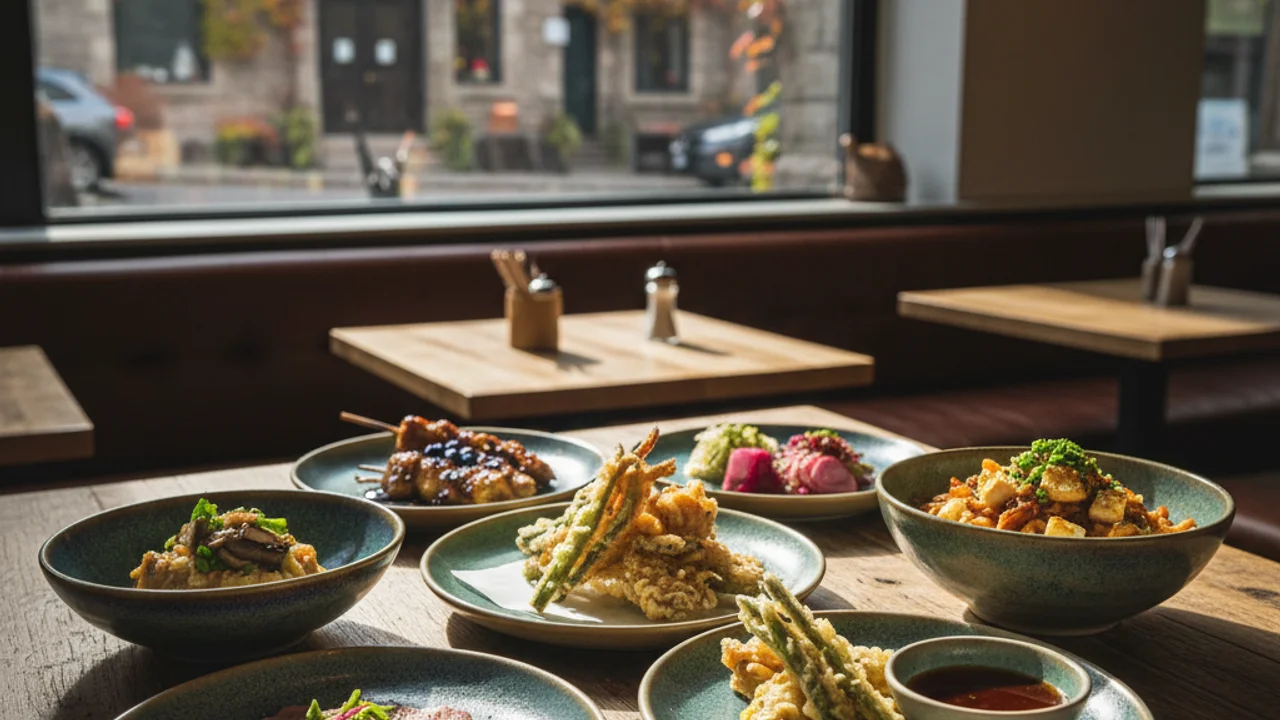
For years, Japanese food in Montréal meant sushi rolls and bento boxes. That is still true in parts of the city. But it is no longer the whole picture. Over the past decade, a smaller, quieter strand of the scene has developed: restaurants and counters that take the Japanese table seriously, not as a curiosity or a trend, but as a tradition worth practising with rigour.
The Montréal Japanese dining scene
Montréal has always had a Japanese food presence, but the depth of that presence has changed. The city now has dedicated ramen counters, sake bars, omakase counters, and izakaya-style restaurants that go well beyond the all-you-can-eat format that once dominated the market.
The shift reflects a broader change in how Montréalers eat. The city's food culture has become more ingredient-focused, more curious about technique, and more willing to sit at a counter and let a chef make the decisions. These are the same instincts that make izakaya culture legible here: the pleasure of a well-made small plate, the ease of shared eating, the comfort of a room that does not take itself too seriously.
Rosemont-La Petite-Patrie, in particular, has become one of the city's most interesting food neighbourhoods: diverse, independent, and dense with kitchens that care about craft. It is not a coincidence that Aji chose St-Zotique Est.
What the izakaya spirit means in Québec
The izakaya concept translates with surprising ease into a Québec context. Both cultures value the long evening, the table as a social anchor, the pleasure of eating a little and drinking a little and talking a great deal. The brasserie and the depanneur-adjacent terrasse are not so different from the izakaya in their social function: a place where the city becomes less anonymous and the day releases its grip.
What the Japanese bring to this format that Québec does not already have is a particular attention to the food itself: the craft behind each small plate, the precision of the seasoning, the specific textures that make edamame or agedashi tofu or yakitori worth ordering rather than merely consuming. The izakaya is casual in atmosphere but serious in kitchen. That combination is rarer than it sounds.
In a Montréal context, the izakaya spirit also means respecting the BYOB tradition and bringing something that matches the food. A bottle of sake, a dry Alsatian white, a light natural wine: these choices are part of participating in the evening, not just arriving and consuming it.
What Is an Izakaya? Japan's Favourite After-Work SpotThe history, etymology, and social culture of Japan's essential gathering place.What to look for in a good izakaya experience
Shared small plates. The menu should be designed for the table, not for individual diners. If every item is portioned for one person, the spirit is missing, even if the food is good.
An open kitchen or counter. Seeing the cooking is part of the experience. A closed kitchen with no visual connection to the work happening inside is a different kind of restaurant.
A sake selection or BYOB policy. Izakaya culture is inseparable from drinking. Whether the establishment curates its own sake list or welcomes your bottle, the drinks should be as considered as the food.
Casual atmosphere with serious kitchen. The room should feel easy and unpretentious. The food should feel precise and considered. The tension between those two qualities is what defines the izakaya at its best.
A pace that belongs to you, not the clock. A good izakaya does not rush you to the door. The evening is the point.
Which Montréal neighbourhood is Aji Bar Sushi & Izakaya MTL located in?
How Aji in Rosemont embodies this
Aji Bar Sushi & Izakaya MTL at 929 St-Zotique Est is a four-seat omakase counter. Chef Yamamoto works directly in front of the guests, visible throughout the service. The format is Japanese counter dining practised with genuine seriousness: each sequence composed fresh that evening, each piece reflecting the week's best deliveries.
The izakaya spirit at Aji is not in the menu format, which is omakase rather than a shared-plates list. It is in the atmosphere: the proximity, the openness, the sense that the room belongs to the people in it and the evening will unfold at its own pace. The counter makes strangers into a community for the duration of the meal. That is the izakaya at its most essential.
The neighbourhood adds its own layer. Rosemont-La Petite-Patrie is a walking neighbourhood, lived-in and independent. Coming to Aji feels like coming to a place, not visiting a concept. That rootedness in a specific block on a specific street is very much part of what makes the experience work.
A practical evening guide
When to go. Wednesday through Saturday evenings are the heart of the schedule. Book one to two weeks in advance for midweek, two to three weeks for Friday and Saturday.
What to bring. Aji operates as a BYOB establishment. A dry junmai sake, a crisp Alsatian Riesling, or a light natural wine pairs well with the counter sequence. Check the current BYOB policy when you book.
How to dress. Smart casual. Clean and considered, but not formal. Skip heavy fragrance: in a four-seat room, it travels.
How long to plan for. The omakase sequence runs roughly 90 minutes. Allow a little more if you want to linger at the end. There is no rush to leave once the sequence is done.
How to get there. Aji is at 929 St-Zotique Est, Montréal, QC H2S 1M9. Accessible by bike, metro (Beaubien), or car. Street parking is available in the neighbourhood.
Japanese Food in Montréal: A GuideThe full landscape of Japanese dining in the city, from ramen to omakase.The Japanese Art of Sharing a MealJapanese meals are shared events, not collections of individual orders. Plates land at the centre, you pour for others before yourself, and Yakitori, Karaage, Edamame: The Classics of the IzakayaThe izakaya menu is built around small, shareable dishes designed to pair with drinks: skewered grilled chicken, Japanese frie- 1Montréal's Japanese dining scene has matured well beyond the sushi-roll era.
- 2The izakaya spirit, shared plates, open kitchen, casual atmosphere, translates naturally to Québec culture.
- 3Look for shared plates, an open kitchen, a sake selection or BYOB policy, and a room that does not rush you.
- 4Aji at 929 St-Zotique Est is a 4-seat omakase counter in Rosemont, where the counter tradition is practised with rigour.
- 5Book one to two weeks ahead, bring something you want to drink, and give the evening room to unfold.
Experience the counter spirit of Rosemont's most considered Japanese table.
Make a reservation