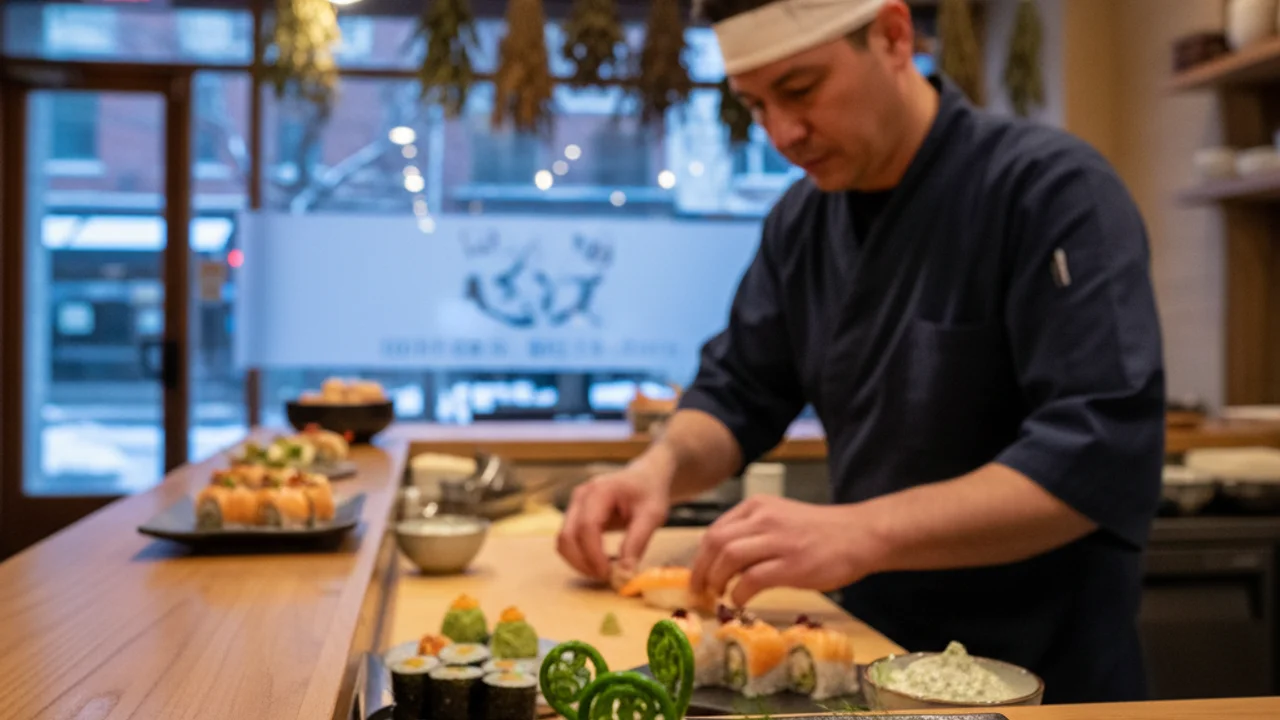
Montréal's relationship with Japanese food has evolved considerably in the past two decades. What began as a handful of Japanese restaurants catering largely to a diplomatic and business community has grown into a layered dining landscape, from all-you-can-eat rolls to some of the most technically demanding counter cuisine in the country. Navigating that landscape is easier when you know what to look for.
Montréal's Japanese Dining Scene
Compared to Toronto or Vancouver, cities with larger Japanese diaspora communities, Montréal's Japanese restaurant scene arrived later and developed differently. The city's bilingual, francophone character shaped the food culture in ways that made mid-range chain sushi less dominant here than elsewhere. Montréalers, particularly in the inner neighbourhoods, tend to gravitate toward independent restaurants with a clear point of view.
The result is a scene that is smaller but more particular than its size might suggest. There are conveyor-belt sushi restaurants, all-you-can-eat buffets, and fast-casual roll spots. There are also a small but growing number of restaurants practicing something much closer to what you would find in Tokyo: counter-format dining, trained itamae, seasonal menus, and a guest experience built around precision rather than volume.
Fast-Casual Sushi vs. Authentic Japanese
Fast-casual sushi and authentic Japanese cuisine share some ingredients, most visibly fish and rice, but the logic behind them is entirely different.
Fast-casual sushi is designed for accessibility and efficiency. Menus are long, rice is often machine-pressed and pre-made in batches, fish is refrigerated and standardized, and the goal is to serve many people quickly at a predictable cost. None of that is morally wrong: it is a different product. The problem arises when the two categories are conflated and a guest expects one thing while receiving another.
Authentic Japanese cuisine, at any level from izakaya to omakase, involves a chef making active decisions about each preparation. What fish is at its peak today. How the rice is seasoned this evening. What a specific guest at the counter might prefer. The itamae relationship, where a trained chef makes each piece to order and presents it directly to the guest, is the core of counter dining. That relationship does not exist in a fast-casual format.
What Is Omakase?Understanding the counter format and the chef-guest relationship at its most complete.Signals of Quality
Three reliable indicators work across almost any Japanese restaurant:
The rice. Sushi rice is the foundation of everything at the counter. Good shari is hand-seasoned with a specific rice vinegar blend, pressed to order, and served at body temperature. It should have texture: each grain distinct, the mass lightly cohesive without being compressed. If the rice is cold, glassy, or sticky in a gluey way, the kitchen is not paying attention to the part that matters most.
The menu size. A well-run Japanese restaurant knows what it can do well. A long menu spanning sushi, ramen, teriyaki, bento, and a dozen specialty rolls is a signal of a kitchen trying to satisfy everyone and mastering nothing. A short, focused menu with clearly sourced fish and seasonal items is a kitchen that knows what it is.
The number of seats. Fewer seats generally means more attention per guest. A 4-seat counter allows a chef to interact with every guest, monitor the pace of the meal, and make each piece with full attention. A 120-seat dining room requires a completely different operation, and the craft-per-plate inevitably suffers.
What does 'itamae' literally mean in Japanese?
Neighbourhood Context
The geography of Montréal's Japanese restaurant scene has shifted over the past decade. The first wave of serious Japanese restaurants clustered in the downtown core and the western part of the Plateau. More recently, the inner east-side neighbourhoods have emerged as the more interesting destination for counter-format Japanese dining.
Rosemont-La Petite-Patrie, in particular, has attracted a concentration of Japanese and Japanese-influenced restaurants that reflects both the neighbourhood's food culture and its economics. The lower commercial rents allow a chef-driven project to be financially viable without requiring the volume of a downtown location.
Why Rosemont Has Become the Address
Three factors converge in Rosemont-La Petite-Patrie that make it particularly hospitable to serious Japanese dining.
First, the neighbourhood's food culture already expects quality and originality. Rosemont diners are accustomed to independent restaurants with strong culinary points of view, which means a counter restaurant serving an omakase menu does not need to explain itself the way it might in a neighbourhood with less food sophistication.
Second, Jean-Talon Market proximity allows seasonal, local sourcing to exist alongside Japanese-imported ingredients. A kitchen that wants to incorporate Québec vegetables and fish into a Japanese framework has the infrastructure to do it.
Third, the neighbourhood's residential character supports the kind of loyal, returning clientele that allows a small counter restaurant to build a reputation without relying on tourist traffic. Aji at 929 Saint-Zotique Est was built for regulars, and Rosemont provides them.
The Express Fusion Lunch on St-Zotique: Tao, Pho, and PokéAji's lunch goes express and fusion: General Tao chicken, Pho, and poké bowls, made with the same care as the evening omakase, on St-ZotiqueSaint-Zotique East: An Address, a NeighbourhoodSaint-Zotique Est is a residential Rosemont street with a strong local character: independent shops, neighbourhood cafes, Père-Marquette par- 1Montréal's Japanese dining scene is diverse, from fast-casual sushi to serious omakase counters.
- 2Fast-casual sushi and authentic Japanese cuisine share ingredients but operate on entirely different logics.
- 3Quality signals: hand-seasoned rice pressed to order, a short focused menu, and fewer seats.
- 4The itamae relationship, chef making each piece directly for the guest, is the heart of counter dining.
- 5Rosemont-La Petite-Patrie has become the address for serious Japanese cuisine in Montréal.
Knowing what you are looking for before you walk through a door changes the meal. In Montréal's Japanese dining scene, that knowledge is the difference between a satisfying experience and an exceptional one.
Experience the Aji counter at 929 Saint-Zotique Est, Rosemont-La Petite-Patrie.
Make a reservation