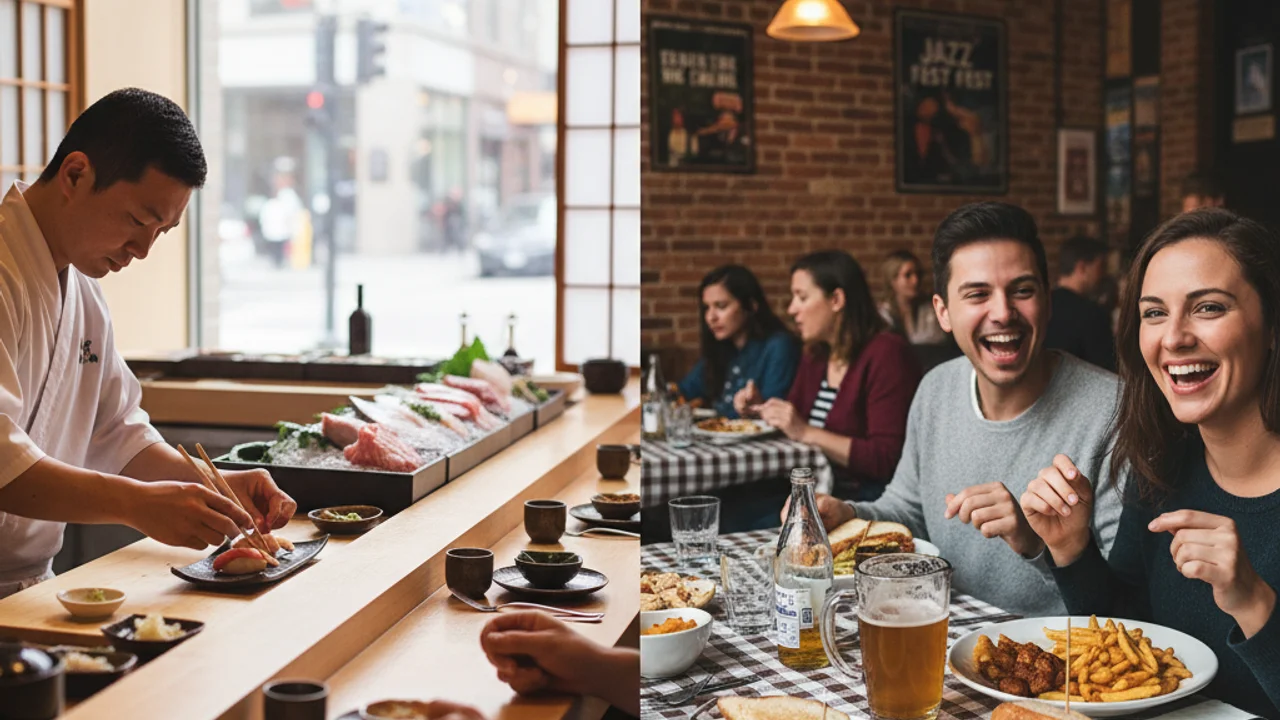
In Montréal, "Japanese restaurant" covers a surprisingly wide range. The same label applies to a 200-seat all-you-can-eat buffet and to a 12-seat counter where a chef works in silence and hands you each piece directly. Understanding the spectrum does not require snobbery: it just requires knowing what you are choosing.
The Full Spectrum of Japanese Dining
At one end: conveyor-belt sushi, kaitenzushi. Plates circulate on a moving belt, guests take what they want, and the meal is designed for speed and accessibility. It is a legitimate format with a long history in Japan, and it does what it sets out to do.
Next: fast-casual roll restaurants. Often brightly lit, with long menus, fusion preparations, and an emphasis on visual appeal over flavor precision. This is where the California roll lives, alongside dragon rolls, spicy tuna cones, and preparations that have more to do with North American tastes than Japanese technique.
In the middle: full-service Japanese restaurants with table seating, a broad menu, and a combination of sushi, cooked dishes, noodles, and set menus. These range from mediocre to excellent, and the format itself does not tell you much about quality.
Moving toward the top: izakaya-style dining. Small plates, sharing culture, sake, yakitori, and a casual but informed approach to Japanese cooking. The food is not always sushi, and the atmosphere is generally convivial.
At the top: the sushi counter and omakase dining. Counter seating, a chef working directly in front of you, a menu that follows the chef's vision or a seasonal program, and a guest experience built on precision and relationship.
What Defines a Sushi Bar
The term "sushi bar" is used loosely in Montréal, often applied to any restaurant that serves sushi. In its strict sense, a sushi bar requires three things: a counter, a chef behind it, and direct interaction between them.
The counter is not just a design choice. It is a working surface where the chef prepares each piece and hands it directly to the guest, sometimes on the back of the hand or fingertip rather than on a plate. The counter is also what allows the chef to monitor the pace of each guest's meal, adjust the sequence, and respond to what they are seeing: who is eating quickly, who is savoring slowly, who seems ready for something richer.
The focused menu is the third defining element. A sushi bar with 80 items is not really operating as a sushi bar: it is a restaurant with a counter. A real sushi counter has a short list, reflects the day's sourcing, and changes with the season. The chef knows exactly what is on it because the chef chose it.
What Is Omakase?The counter format at its most complete: chef in charge, guest trusts entirely.Reading the Quality Signals
Before you enter any Japanese restaurant in Montréal, a few signals are visible from the outside and from the menu.
Menu size: a menu with 60 or more items is a flag. Good sushi requires daily sourcing decisions, and no kitchen can do that across 60 items without compromise. A menu of 15 to 25 items, clearly sourced and seasonally adjusted, is a better sign.
Number of seats: a 200-seat Japanese restaurant is not the same operation as a 4-seat counter. Volume and precision do not coexist easily in this format. Fewer seats typically mean more attention per guest and a higher standard of craft per piece.
Counter presence: a physical counter is not necessary for quality, but its presence at a restaurant that uses it for service, not just as a bar, is a meaningful signal. It indicates a kitchen that has thought about the guest relationship and designed the space around it.
What does kaitenzushi refer to?
Why the Counter Format Matters
The counter creates a specific kind of intimacy that a dining room cannot replicate. You watch the fish being cut. You see the rice being pressed. You receive each piece the moment it is made, while the rice is still at body temperature and the fish is at the exact state the chef intended.
The counter also makes conversation natural. You can ask what a specific fish is, where it was sourced, what the chef recommends for the next piece. That exchange, direct and unmediated, is part of what the format offers. It is not available at a table with a server and a printed menu.
Finally, the counter removes the illusion that every guest has the same meal. At a serious counter, the chef adjusts for each person: a slightly larger piece for someone eating slowly, a different sequence for someone who mentioned they do not eat shellfish, a stronger recommendation for a regular who trusts completely. The counter is where Japanese hospitality, omotenashi, is most fully expressed.
What Aji Offers at 929 Saint-Zotique Est
Aji Bar Sushi & Izakaya MTL is a counter-format restaurant. The 4-seat counter faces the kitchen, and each piece is made to order and handed directly to the guest. The menu is focused and seasonal, with fish sourced for quality rather than volume.
The format is not for everyone. If you want a large table, a long menu, and the ability to order and reorder at your own pace without interaction, there are good options for that elsewhere in Montréal. Aji is for guests who want the counter experience: the direct relationship with the chef, the precision of each piece, and the rhythm of a meal that unfolds at the counter's pace.
The Express Fusion Lunch on St-Zotique: Tao, Pho, and PokéAji's lunch goes express and fusion: General Tao chicken, Pho, and poké bowls, made with the same care as the evening omakase, on St-ZotiqueSaint-Zotique East: An Address, a NeighbourhoodSaint-Zotique Est is a residential Rosemont street with a strong local character: independent shops, neighbourhood cafes, Père-Marquette par- 1The Japanese dining spectrum runs from conveyor-belt kaitenzushi to full omakase counter dining.
- 2A sushi bar is defined by three elements: a counter, a chef behind it, and direct guest interaction.
- 3Menu size is a reliable quality signal: fewer, better-sourced items indicate a focused kitchen.
- 4Fewer seats generally mean more attention per guest and higher craft per piece.
- 5The counter format allows omotenashi, Japanese hospitality, in its most direct form.
Choosing between formats is not about budget or prestige: it is about what kind of evening you want. The counter is a specific offer. At Aji, it is the only offer, and it is made with full commitment.
Book your seat at the Aji counter, 929 Saint-Zotique Est, Rosemont, Montréal.
Make a reservation