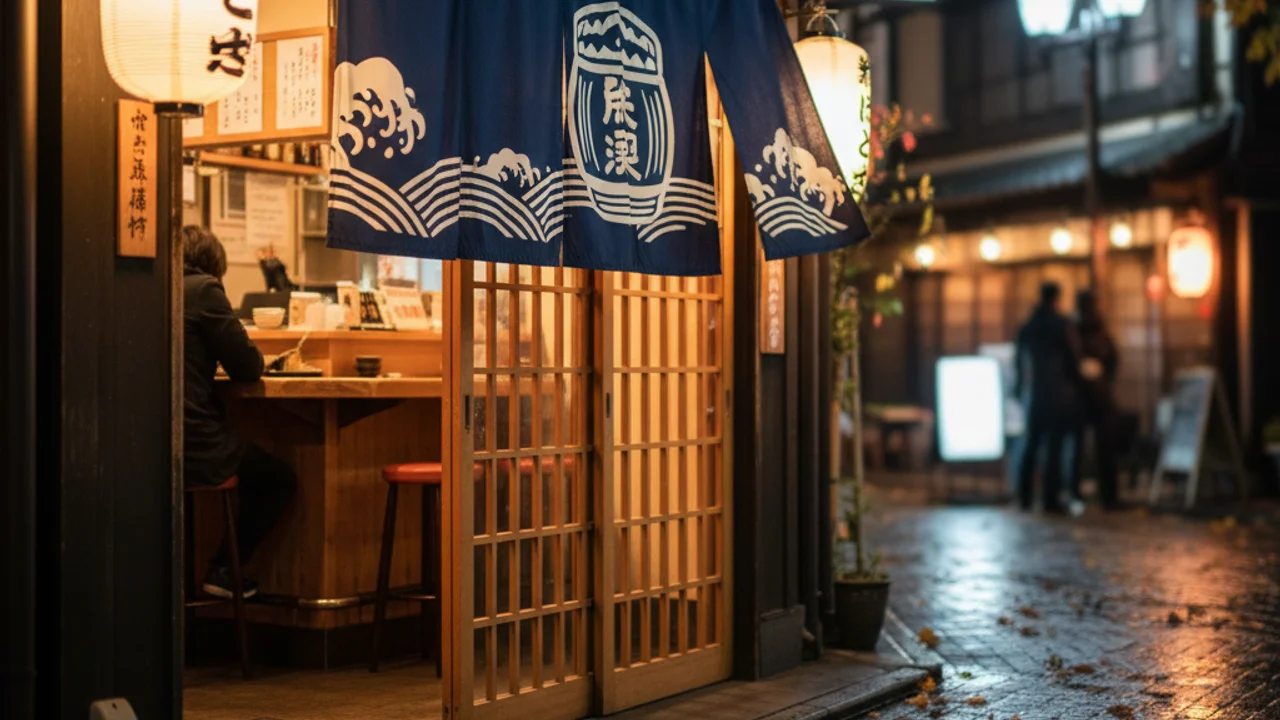
In Japan, the question "where should we go after work?" most often leads to an izakaya. Not a restaurant in the formal sense, not a bar in the Western sense, but something in between: a place designed for the pleasure of staying, eating a little, drinking a little, and doing it all over again until the evening has quietly become night.
What the word actually means
Izakaya (居酒屋) is built from three characters. I (居) means to be, to stay, to remain. Sake (酒) is the general Japanese word for alcohol, not just rice wine. Ya (屋) means a shop, a house, an establishment. Put together: a place where you stay and drink. The emphasis on staying is significant. An izakaya is not designed for a quick meal. It is designed for an evening.
The format dates to the Edo period, when sake shops began allowing customers to drink on the premises rather than taking bottles home. Food followed naturally: something to slow the drinking, something to share, something to bring people back the next evening. Over three centuries, the izakaya became one of Japan's most enduring social institutions.
How it differs from a formal restaurant
The defining difference is structure, or rather the absence of it. A formal Japanese restaurant organises the meal in a deliberate sequence: appetisers, a main, dessert, or a full kaiseki progression. You eat in order, you finish, you leave.
At an izakaya, there is no sequence. You order what you want, when you want, sharing everything at the table. A plate of edamame arrives at the same time as grilled chicken skewers. Someone orders another round of sake and also a plate of gyoza. The food and the drinks arrive in waves, and the conversation determines the pace, not the other way around.
The atmosphere is deliberately informal. Staff may call out greetings when guests arrive. Tables are close together. Noise is welcome. The goal is ease, not ceremony.
Yakitori, Karaage, Edamame: The Classics of the IzakayaWhat to order, how to pair it, and how to eat izakaya-style.The culture of shared plates and drinking
At an izakaya, no plate belongs to one person. Everything lands in the centre of the table. You take what you want, you leave what you don't, you order more if the conversation is still going. This communal approach to eating mirrors a broader Japanese value: the meal is a shared event, not a series of individual transactions.
Drinking follows the same principle. In Japanese drinking culture, you do not pour your own glass. You pour for the person next to you, and they pour for you. Watching each other's glass is a form of attention, of care. It keeps the group connected across the table.
The food at an izakaya is designed to complement the drinks, not to replace them. Portions are small, flavours are direct, and the selection covers salty, rich, light, and acidic options in roughly equal measure, so there is always something that pairs with whatever you are drinking.
What does the 'i' character in izakaya (居酒屋) mean?
Social function in Japan
The izakaya occupies a specific and important role in Japanese social life. It is one of the few spaces where the rigid hierarchies of the office are softened. Colleagues who would not dare speak casually to a senior during working hours sit side by side at an izakaya counter and talk freely. The informality is intentional and protected: what happens at the izakaya stays there.
The Japanese even have a term for the post-work drinking ritual:nomikai (飲み会), a drinking gathering. These are not optional social events at many Japanese companies: they are part of building the relationships that make professional life function. The izakaya is the setting where those relationships form.
Montréal parallels
Montréal has its own long tradition of the neighbourhood gathering place: the tavern, the brasserie, the terrasse. The izakaya maps naturally onto that culture. Small plates, shared food, a relaxed room, an open kitchen, drinks that slow the pace of the evening: these are not foreign ideas in a city built around the pleasures of lingering at a table.
Aji in Rosemont-La Petite-Patrie brings this spirit to 929 St-Zotique Est. The counter format, the proximity to the chef, the emphasis on seasonal ingredients and shared experience: it is an izakaya sensibility expressed through a Montréal lens, at a level of craft that the format rarely achieves.
The Izakaya Experience in MontréalWhat the izakaya spirit looks like in a Québec context, and what to look for.The Japanese Art of Sharing a MealJapanese meals are shared events, not collections of individual orders. Plates land at the centre, you pour for others before yourself, and- 1Izakaya (居酒屋) means 'a place where you stay and drink': the format is built around lingering.
- 2It differs from a formal restaurant in that there is no fixed sequence: you order freely, share everything.
- 3Communal eating and shared pouring are central to the izakaya culture.
- 4In Japan, the izakaya softens workplace hierarchies and builds social bonds.
- 5Montréal's neighbourhood culture maps naturally onto the izakaya spirit.
Come experience the counter spirit at Aji, Rosemont's Japanese gathering place.
Make a reservation