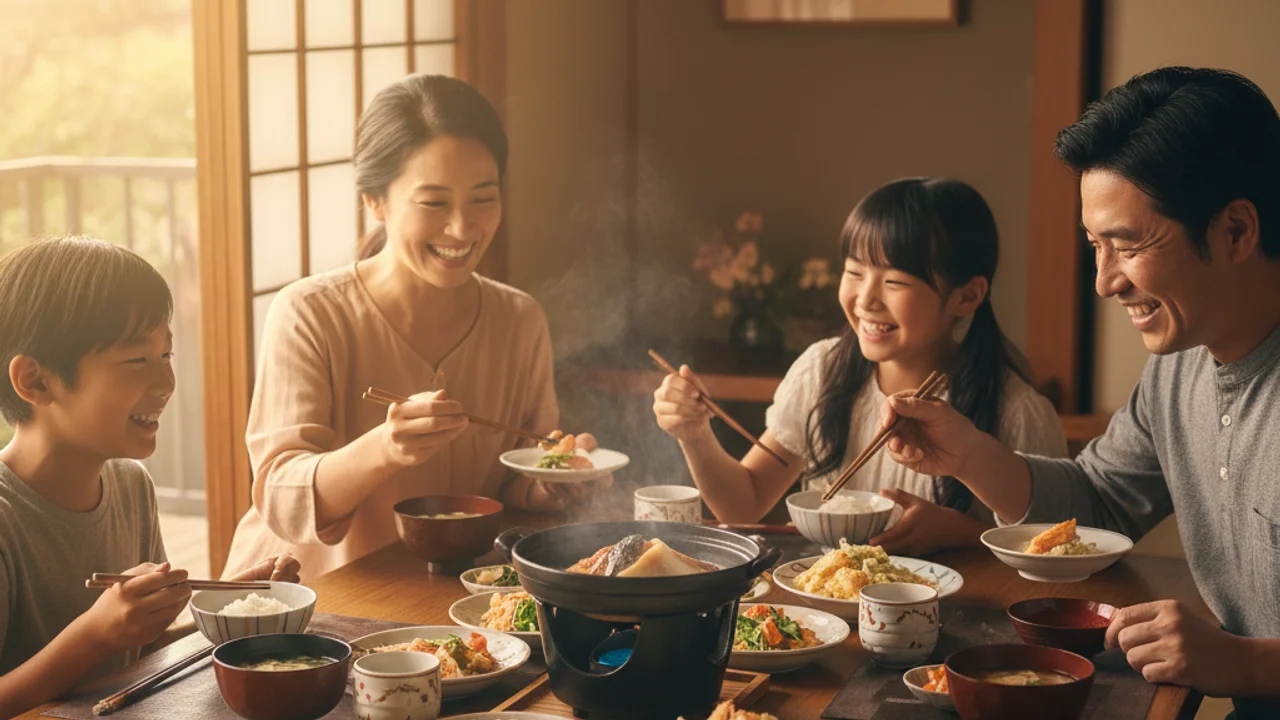
Food in Japan has always been understood as a social act. What you eat matters, of course: the quality of the ingredients, the skill of preparation. But equally important is how the meal is shared, who serves whom, and how the act of eating together reinforces the bonds between the people at the table.
Shared plates vs. individual portions
At a North American dinner table, each person typically orders their own plate and eats from it alone. The dishes arrive separately, the portions belong to the individual, and sharing is the exception rather than the rule. The meal is a sum of private experiences happening simultaneously.
Japanese communal dining works differently. At an izakaya, a family dinner, or any casual gathering, plates are ordered for the table and placed at the centre. Each person takes what they want, leaves the rest available, and the rhythm of ordering is calibrated to the conversation. The meal belongs to the group, not to any individual diner.
This is not simply a different serving format. It changes the dynamic at the table. When food is shared, people pay attention to what others are eating and enjoying. They notice when a plate is nearly empty and order more. They hold back on a dish they particularly like so that others can have some. The meal becomes a small, continuous exercise in attentiveness.
Pouring for others: a small gesture with weight
In Japanese drinking culture, you do not fill your own glass. You fill the glasses of the people around you, and you wait for someone to fill yours. This practice is called o-shaku (お酌): the act of pouring for another person.
The custom keeps the group connected. To pour for someone, you must pay attention to their glass, notice when it is getting low, and make a small physical gesture of service. This is not servitude: it is presence. And when someone pours for you, you are receiving that attention in return. The back-and-forth of pouring becomes a quiet conversation that runs underneath the spoken one.
To pour only for yourself, or to refill your own glass before attending to others, is seen as self-absorbed in this context. Not a serious offence, but a small lapse of social grace that people notice. The gesture matters because what it signals matters.
What Is an Izakaya? Japan's Favourite After-Work SpotThe origin, culture, and social role of Japan's most beloved gathering place.The itamae at the counter
The word itamae (板前) means "in front of the board": the chef who stands at the cutting surface directly facing the guests. At a sushi or omakase counter, the itamae is not hidden in a kitchen. He works in plain sight, within arm's reach, and the counter is designed to make that proximity the central fact of the meal.
This proximity gives the itamae a dual role. He is a craftsperson, of course: sourcing, preparing, slicing, pressing, seasoning each piece with precision. But he is also a host, reading the room, adjusting the pace, responding to what he sees in front of him. When a guest leans in with curiosity, the itamae explains. When a guest seems quiet or uncertain, he might offer a small context before the next piece arrives.
The relationship between the itamae and the guests at the counter is one of genuine exchange. The guests trust the chef's judgment; the chef attends to the guests' pleasure. That mutual attention is what makes a counter meal different from ordering off a menu in a dining room.
What does the Japanese custom of o-shaku involve?
How this differs from North American habits
North American dining culture is built around individual choice and individual ownership of the plate. You order what you want, you eat what you ordered, and the server clears your plate when you are done. Sharing is something you negotiate explicitly, usually as a deliberate departure from the norm.
Japanese communal dining inverts that assumption. Sharing is the default. Individual portions, when they appear, are the departure from the norm. This is not a minor difference: it changes who has authority over the meal, how decisions are made, and what kind of attention people bring to the table.
Neither approach is better. They reflect different values: autonomy and personal choice on one side, group cohesion and mutual attention on the other. When you sit down to a Japanese communal meal, knowing which culture you are stepping into helps you participate more fully.
How Aji embodies this spirit
At Aji's counter on St-Zotique Est, the itamae tradition is central to the experience. Chef Yamamoto works directly in front of the four counter guests, visible throughout the evening. Each piece he prepares is placed in front of the person it was made for, a small private gift within a collective meal.
The omakase format itself is an act of trust that echoes Japanese sharing culture. You hand over the decision-making to the chef, just as a guest at an izakaya table might defer to someone else's taste when choosing the next dish. The meal is built on mutual attention, on the chef watching the guests and the guests watching the chef.
That reciprocity, quiet but constant, is what the Japanese art of sharing a meal looks like in practice.
Yakitori, Karaage, Edamame: The Classics of the IzakayaThe dishes that anchor the communal izakaya table and how to order them.The Izakaya Experience in MontréalMontréal's Japanese dining scene has matured significantly. The izakaya spirit, shared small plates, an open kitchen, a relaxed atmosphere,- 1Japanese communal meals centre on shared plates: the food belongs to the table, not to individual diners.
- 2O-shaku, pouring for others before yourself, is a form of attentiveness that keeps the group connected.
- 3The itamae at a counter is both craftsperson and host, reading the room as much as preparing each piece.
- 4North American dining culture defaults to individual portions; Japanese communal dining defaults to sharing.
- 5At Aji, the counter format and omakase structure both reflect the itamae tradition of mutual attention.
Experience the counter spirit, the itamae tradition, and the art of sharing at Aji in Rosemont.
Make a reservation